Showing posts with label 1977. Show all posts

Friday, 7 October 2022

Suspiria (1977)


 ☆ ☆ ☆ ☆ ½

Suspiria (1977) – D. Argento

 I don’t usually go for movies with gore or slasher-type killers but writer-director Dario Argento brought something different to horror in the 1970s. Influenced by Mario Bava, Argento uses garishly coloured sets and lighting and takes the giallo (Italian pulp mystery fiction) as his genre of choice. But with Suspiria, Argento moved more clearly into supernatural territory. Suzy Bannion (Jessica Harper) is the American ballet student who arrives in Germany to study at the Tanz Academy led by headmistress Madame Blanc (Joan Bennett, star of many Fritz Lang films of the ‘40s) and strict teacher Miss Tanner (Alida Valli, star of The Third Man and Hitchcock’s Paradine Case in the ‘40s). She arrives on a rainy night and sees another student fleeing the school (subsequently murdered).  Although she originally wishes to stay off-campus, after a strange hallway encounter that leaves her woozy, she is moved to a room in the main building with the other students, including Sara (Stefania Casini), who becomes an ally.  Argento uses weird camera angles and tracking shots to add to the ominous feel of the place (and a maggot infestation makes it worse). Rumours swirl and eventually Suzy heads to the local psychiatric hospital/university to ask about witchcraft (to a sadly dubbed Udo Kier). What she learns makes her even more suspicious about the leaders of the dance academy, particularly when Sara disappears. Of course, we soon discover that witchcraft is real but Argento manages the mystery elements of the plot expertly (a talent he was later to lose), even as the whole thing resembles a dream… or nightmare.  A spooky masterpiece elevated by an amazing score by the rock band Goblin but punctuated with some bloody violent set-pieces (enter at your own risk!). The 2018 remake with Tilda Swinton pales in comparison but is altogether a different beast.


Monday, 2 December 2019

The Ascent (1977)


☆ ☆ ☆ ☆ ½


The Ascent (1977) -- L. Shepitko

During the German invasion of the U. S. S. R. during WWII (circa 1942), two Russian partisans leave their small stranded group (including women and children) to search for food at a nearby farm.  One (Sotnikov) is a soldier and former maths teacher with a terrible wheezing cough, the other (Rybak) is earthier and sturdier and leads the way.  Their path leads through snowy woods and fields (shot stunningly in high contrast B&W) and when they are accosted by a small band of Germans, their only escape is to roll through the snow (and Rybak must drag Sotnikov after he is shot in the leg).  Sotnikov does manage to shoot one German before their escape, which ends up being a problem for them when they are later captured.  Director Larissa Shepitko (who died only 2 years later in a car accident at 41) provides viewers with a raw and visceral experience laced with expressionistic almost hallucinatory touches (and experimental film-making), as we face death at nearly every turn with these characters and observe how they hauntingly try to come to terms with their mortality.  For Sotnikov, acceptance of death is easy but only because he knows that he has sacrificed for his principles and taken the moral high road (indeed, he becomes a Christ-like figure by the end of the film). For Rybak, death is something to be avoided and, by any means necessary, including betrayal (and he becomes a Judas-like figure as the film takes on the qualities of a parable as it nears its conclusion). In the end, for me, Shepitko’s film loses something as it becomes more transparently allegorical -- the existential intensity of the experiences and the difficulty of the moral decisions alone were enough to elicit a feverish spiritual transcendence without having to reference Christ on the cross so directly.  Of course, in the Soviet Union in the Seventies, such a move may have been brave and perhaps liberating in its defiance – or it may have been accepted as “nationalistic” partisan pride.  For film students, however, The Ascent can be enjoyed wholly as a masterclass in cinematic technique.   


Sunday, 9 June 2019

21 Up (1977)


☆ ☆ ☆ ☆

21 Up (1977) -- M. Apted

The interviewers are starting to broach adult topics (sex, politics) and our subjects are beginning to comment on the experience of being filmed. Will they regret the honesty they've shown thus far? Personality and affective tone are taking some from similar backgrounds in different directions. What will the future hold (or more properly what did the future hold?)? (2009 review)


Sunday, 16 September 2018

Close Encounters of the Third Kind (1977)


☆ ☆ ☆ ☆ ½


Close Encounters of the Third Kind (1977) – S. Spielberg

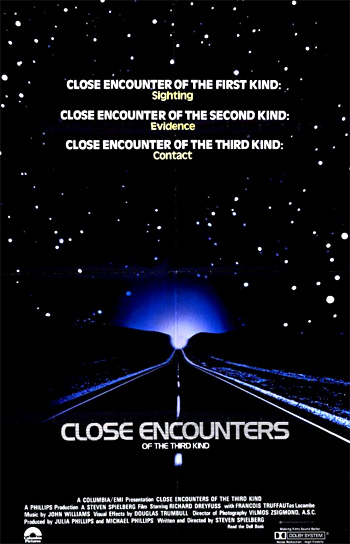
Forty years later, Spielberg’s examination of the events leading up to our first encounter with aliens (the third kind = actual contact beyond sightings or discovering physical traces) still retains a sense of child-like wonder at new and amazing things.  In fact, the film impacted me so much when I was a child myself that I ended up taking a pilgrimage to Devils Tower, Wyoming, in the early 1990s – the butte is awesome enough on its own but its association with this film adds an extra weirdness factor that makes it even more compelling.  And, yes, compelling is the operant word here, because the film depicts how, after an encounter of the first kind, a number of humans (including chiefly Richard Dreyfuss and Melinda Dillon) are drawn to this spot where it appears that the aliens will land.  But the film starts a few weeks earlier and shows us how the obsession with aliens takes over the lives of these ordinary people, interspersed with shots of Professor Francois Truffaut’s academic investigation into alien encounters. Of course, the special effects (coordinated by Douglas Trumbull, who had earlier done 2001: A Space Odyssey) are great (and old-school, not CGI) and the five-tone message that unlocks the ability to communicate with the aliens became seared into our brains (although the rest of John Williams’ score is less memorable).  Overall, the film makes you want to believe in (friendly) aliens, even though Spielberg leaves it for viewers to go deeper into the ideas and outcomes introduced here.
  

Monday, 17 August 2015

Providence (1977)


☆ ☆ ☆ ☆


Providence (1977) – A. Resnais

Another of Resnais’s peculiar experiments in narrative form, teasing us to separate John Gielgud’s creative will (he is a novelist) from his reality.  You see, everything that crosses Gielgud’s mind, as he comically and profanely suffers terrible gastric problems, appears on screen. These thoughts, enacted by Dirk Bogarde, Ellen Burstyn, David Warner, and Elaine Stritch, involve his closest family members cold-heartedly inflicting terrible lacerations on each other…and on Gielgud himself (to which he often protests -- his mind must be wandering). As in other Resnais films, the viewer must continually struggle to make sense of the proceedings – and I can’t quite guarantee that my interpretation is the correct one.  To wit:  the final act of the film is suddenly an idyll, with all the characters sitting down to a wonderful country luncheon for Gielgud’s 78th with friendly frolicking dogs and a glamourous 360 degree camera move to boot.  Miklos Rozsa’s score here evokes romantic films of years gone by, whereas earlier in the film’s first half it was reminiscent of his noir years; in either case, the score is cranked and intrusive, surely another of Resnais’s conscious efforts to remind viewers that all is fiction.  In the end, you can’t quite be sure which half of this story is reality and which is Gielgud’s new novel, which is fantasy and which is anxiety fuelled conjuring. Of course, neither may be the truth because the added twist is that Resnais wants us to know that the real “fiction” he is focused upon is our memories of our own lives, even as we submit unto death.
  

Monday, 1 June 2015

Annie Hall (1977)


☆ ☆ ☆ 


Annie Hall (1977) – W. Allen

No, I hadn't really watched Annie Hall before. Yes, it's Woody Allen and maybe that's all you need to know to know what the movie is about (OK, it's his take on relationships). It is exactly what you expect, but funnier and more human than anything Woody's done lately. Diane Keaton is a revelation.


Monday, 8 December 2014

Stroszek (1977)


☆ ☆ ☆ ☆ ½


Stroszek (1977) – W. Herzog


Apparently, this is the film that Joy Division’s Ian Curtis watched the night he died and it is pretty bleak.  Herzog’s very unique perspective on life is made manifest by the script he wrote, the actors he chose, the locations he found, and an incredible dancing chicken.  Bruno S. (previously the star of Herzog’s Kaspar Hauser) plays a street musician who has spent most of his life institutionalized – in fact, he is playing himself, although there is apparently little improvisation in the film (so we are really getting Herzog’s “ecstatic truth” version of Bruno).  After being released from jail, Bruno hooks up with Eva, a down-on-her-luck prostitute, and they get messed around by her pimps. Berlin turns so depressing that they decide to travel to the USA with Herr Schweitz (an elderly eccentric, also featured in Kaspar Hauser) who has a nephew in Wisconsin.  Arriving there (after a journey that evokes many moods), they get a trailer home, jobs as a mechanic and waitress (respectively), and settle in outside a truckstop.  Herzog’s dead eye sees some black humor in this situation – as the characters struggle to make a living and American capitalism tightens its noose around them.  In the end, there is only the dancing chicken – an apt metaphor for our workaday lives if ever there was one and fully in keeping with Herzog’s heightened (but dark) sense of the absurd.


Monday, 20 January 2014

The Last Wave (1977)

☆ ☆ ☆ ☆

The Last Wave (1977) – P. Weir

This is Weir’s white western take on the dreamtime, the aboriginal spiritual plane.  He doesn’t purport to understand and he passed the script through some tribal elders and added material that they suggested.  The indigenous actors here, apart from David Gulpilil (who famously appeared in Walkabout), are non-professionals brought in by Nandjiwarra Amagula who plays Charlie, the elder with the magical powers. Richard Chamberlain is the protagonist with whom we identify as he makes contact with a secretive Aboriginal group through his involvement as their lawyer in a murder case and with the dreamtime through a series of premonitions and visions.  The film is full of foreboding from start to finish and a persistent low rumbling on the soundtrack keeps viewers on edge. A very mysterious film, filled with beautiful images, that ties up some loose ends, but leaves an ominous feeling in the mind. Perhaps this has something to do with white destruction of indigenous cultures?


Sunday, 24 February 2013

Star Wars (1977)


☆ ☆ ☆ ☆ ½


Star Wars (1977) -- G. Lucas

Famously (for me at least), I first saw this at age 9 at the Cinema 93 in Concord, New Hampshire with my dad.  Now some 35 years later, how does it hold up? In truth, it is hard to watch without the emotional resonances of a small boy (and for this I give it 4.5 stars -- a tough feat to accomplish).  But the plot is wafer thin, despite the mythology woven around it in a few choice scenes.  All flash & bang & action glued together with witticisms (that later became the formula for "I'll be back!" and countless other action movie one-liners).  And of course the movie world was irrevocably changed by the fortunes made.  Now we must live with the blockbusters and Hollywood's slavish devotion to them and their sequels.


Wednesday, 2 May 2012

La Soufriere (1977)


☆ ☆ ☆ ☆ ½

La Soufriere (1977) – W. Herzog

Herzog goes to a Caribbean volcano on the day it is meant to erupt to visit a man who refuses to leave the town, despite the fact that it means his certain death (and Herzog's?). Haunting images of the deserted town and billowing sulfur clouds. Great narration, as usual, in Herzog's awesome accented English... 


Tuesday, 1 May 2012

A Grin Without A Cat (1977)


☆ ☆ ☆ ☆ ½


A Grin Without A Cat (1977) – C. Marker

Unbelievable melange of '60s and '70s leftists fighting the power and eventually falling into disarray. Chris Marker's idiosyncratic style (a cat parade, bemused voiceover narration) encases a hypnotic collection of found footage of world leaders (Castro, Mao, Allende), forgotten European union officials, some communists, the sadly misled, and a million students engaged with political theory in a way we may never see again.