Showing posts with label 2013. Show all posts

Monday, 25 May 2020

Hard to Be a God (2013)


☆ ☆ ☆ ☆ ½


Hard to Be a God (2013) – A. German

This is truly “film-making as commitment” (to an alternate reality) and not for the faint-hearted.  Russian director Aleksei German, a contemporary of Tarkovsky, in his final film, uses another sci-fi novel by the writers whose work was filmed as Stalker (by Tarkovsky, 1979) to barf up an insane vision of Hell.  But oh! what a terrifyingly beautiful hell, if there be beauty in an image (in rich B&W) no matter how disgusting or degrading!  And Hell it is, because we are asked to observe (nay, almost participate in) a medieval culture undergoing a purge of its intellectuals, with an assortment of Churchmen and members of The Order swarming like ants over everything.  Above it all, sits Don Rumata (Leonid Yarmolnik), covered in less filth than the rest, and often wearing some cool looking armour -- and occasionally blowing a soulful saxophone. Yes, really, because it turns out that the Don is actually a scientist from Earth and, despite their resemblance, these medieval times are not on Earth but instead on another backwards planet.  What the Don is up to is hard to say.  Other reviews suggest that, despite the prime directive, he is actually hoping to bring on the Renaissance (or at least stop the purge of “wise guys” – the subtitles call them this). To me, he seems to roam royally through a mud-stained city, above the fray (as I said), but occasionally getting right into it, snorting some mud (no really), pushing his slaves around or joking with them, wryly bearing witness to the dozens of hanged men and piles of rotting corpses on the ground.  He is rumoured to be descended from gods himself, treated with awe and respect, and perhaps therefore immune from attack.  He is able to thwart all those who do harbour malice against him – and we are glad because he seems a rather charming fellow. But he is immersed in a surreal, sensuous, even nonsensical world – and clearly knows it – but he does not let on what it is all about, nor does the director, and all the helpless viewer can do is take in the sordid experience with astonished admiration for the intensity of the vision and craft behind it all. The Don doesn’t want to leave (back to Earth) and maybe neither do we, despite the three-hour length.  I kid you not.

Thursday, 24 October 2019

Ida (2013)


☆ ☆ ☆ ☆


Ida (2013) – P. Pawlikowski

I really enjoyed Pawel Pawlikowski’s Cold War (2018), so I thought I would go back and look at his previous film (also in black and white) to take a better measure of his skill.  And again, there is a gorgeous stylishness to this work – with shots that are so beautifully framed that they might stand alone as photographs.  The story is on a smaller scale, focused on a young woman (Agata Trzebuchowska) about to take her vows as a nun who is encouraged to meet her only living relative, an aunt (Agata Kulesza), before she commits to the sisterhood.  The aunt, Wanda, reveals that the young woman, Anna (but really Ida), is actually Jewish and that her parents were killed during the war.  They travel to find their graves in a rural town in Poland, discovering more than they asked for (although suspected or known by the aunt).  Agata Kulesza gives Wanda a lived-in feeling, portraying a character who has lived beyond her period of true moral engagement and now simply avoids the truth (and the pain).  As Anna, Agata Trzebuchowska is more subdued (repressed even) but much is revealed in the final moments of the film.  The film is brief (80 minutes) but it captures these people and this time (1962) and the choices they have made and must make.  But more than anything, the film looks beautiful.


Saturday, 28 October 2017

A Touch of Sin (2013)


☆ ☆ ☆ ☆


A Touch of Sin (2013) – Z. Jia

Not quite what I expected from director Zhangke Jia but perhaps even better because of that.  I’d already seen Platform (2000) and The World (2004), which I recall as being character-driven realist dramas set in a China engaging with capitalism and all its problems.  That theme continues here but Jia has drawn four violent “true crime” stories from the news and dramatized them with a startling “in your face” quality that seemed absent in the previous quieter features.  The stories are interlinked by virtue of overlapping locations (and briefly glimpsed characters) but they don’t really come together to create a gestalt.  What they do share is the sense that China is now under the sway of a very powerful rich elite who exploit and subjugate those with lower status (particularly women, perhaps).  It seems surprising that Jia was able to express these problems openly from Mainland China or perhaps criticism of the effects of capitalism is still in line with government views despite the cultural changes.  Briefly, the events on display involve a man angry with his local village elder for selling out their community and taking bribes, a young man who freely uses a handgun for senseless violence (and to steal designer bags), a sauna receptionist who fends off businessmen demanding sex (with a martial arts wuxia styled attack), and another young man who is subjected to a number of low paying and degrading jobs (including in a brothel for rich elites) resulting in his total alienation.  Physical violence is present in all the tales, often shockingly and graphically so, but documenting the moral and spiritual violence that is done to the main protagonists may be Jia’s real aim.  He also has a great eye for Chinese locales, frequently showing his characters as tiny figures dwarfed in the face of giant factories or desolate rural landscapes, powerless as they also are in society.


Saturday, 5 December 2015

Short Term 12 (2013)


☆ ☆ ☆ ☆


Short Term 12 (2013) – D. D. Cretton

Emotionally raw look at workers and youth in a residential treatment facility that is a total downer because the focus is on the aftermath of abuse they’ve suffered at the hands of their parents. However, like many downer movies, this is also uplifting in that it highlights people’s ability to cope with extreme situations.  The acting is naturalistic and these people felt real – only occasionally does the script lead them to be a bit more overt about their feelings/problems than you might expect.  That said, people hurting this bad might actually cross that line into awkward self-exposure as a cry for help.  Brie Larson is the backbone of the film, as the lead line worker who has a similar background to many of the kids in the facility and struggles to keep her balance as life keeps happening to her.  Not the kind of film I would normally choose for escapism but I’m glad I did.    


Saturday, 21 March 2015

The Wind Rises (2013)


☆ ☆ ☆ ☆


The Wind Rises (2013) – H. Miyazaki

Miyazaki’s last film does have an elegiac feel (and it isn’t for children).  It’s set in the decades leading up to WWII but only comments on Japan’s growing militarization in passing (despite having some scenes in Nazi Germany).  Apparently, Miyazaki first published a manga featuring his telling of aeronautic engineer Jiro Horikoshi’s bittersweet story but I have to guess that this beautiful moving picture rendering stands head and shoulders above that.  Indeed, there are so many dazzling moments of animation, it might be possible to watch the film without sound and just gawk.  The scenes of the 1923 Great Kanto Earthquake are incredible.  The story itself feels a bit too long and, despite numerous fantasy sequences featuring an Italian airplane designer, it is otherwise determinedly realistic – up until the sad end.  An unusual film on which to end his career perhaps, but undoubtedly important to Miyazaki himself.


Friday, 16 January 2015

Like Father, Like Son (2013)


☆ ☆ ☆ ☆


Like Father, Like Son (2013) – H. Kore-eda

I’m a big fan of director Kore-eda (Maborosi, After Life, Nobody Knows) and his often poignant slices of Japanese life.  Crucially, he often begins his screenplays with a premise or set-up that he then follows through more or less logically and realistically to its appropriate conclusion.  His previous film, I Wish, focused on two young brothers who are separated by their parents’ divorce and how they arrange to transcend the space between them.  Here, more dramatically, two couples discover – six years later – that their sons were switched at birth and the film focuses on how they resolve this problem (i.e., do they choose to exchange their children or keep the boys they’ve raised, although not blood-related).  But Kore-eda uses this premise to focus in on one of the fathers, Ryota, a career-minded and emotionally constricted absent dad who has failed to forge a close relationship with his son. The unexpected event therefore allows him a chance to start again – or does it?  It also highlights the age-old question of nature vs. nurture as we are invited to decide whether the boys’ contrasting personalities reflect the personalities of their real dads or their adopted dads (who are also contrasted by being nouveau riche or on the poorer side). A lot of food for thought and some beautiful moments but also colder and more reserved than we often see from this director, likely due to the problematic central figure.


Tuesday, 28 October 2014

Dallas Buyers Club (2013)


☆ ☆ ☆ ☆


Dallas Buyers Club (2013) – J.-M. Vallee


There’s the movie made and the movie not made.  Over at the New York Times, A. O. Scott alerts us to the movie not made by director Jean-Marc Vallee, a movie about the real fight to stay alive and the solidarity and spirit of the gay community in response to AIDS.  That would be a good and potentially provocative movie (to some audiences). However, we need to consider the movie made instead wherein a homophobic and redneck straight man becomes an angel of sorts for those suffering from HIV/AIDS by investigating and then illegally importing experimental drugs that the FDA was slow in approving.  That man (the real life Ron Woodroof) is played by Matthew McConaughey, transformed by a 50 pound weight loss into a gaunt sick man.  Jared Leto plays his transgender business partner.  As you know, both won Oscars. If there can be a feel-good movie about AIDS, then perhaps this is it.  Shot on an extremely low budget, it doesn’t show and instead manages to maintain a spirited vibrancy, sense of humour, and righteousness, even though it isn’t the movie not made.


12 Years a Slave (2013)


☆ ☆ ☆ ☆


12 Years a Slave (2013) – S. McQueen

A horror movie in all respects -- except for the usual overt trappings of the genre.  For example, instead of creepy music, we get the dramatic cues of the typical Oscar-winning drama.  This was really the only drawback for me. Director Steve McQueen already displays the terrible realities of slavery: the brutal physical torture (hard labour but also whippings, sexual assault, and lynchings) and the chilling psychological torture (being separated from family, not knowing whether to vie for positive treatment from the master and be judged for doing so by other slaves, the constant wish to take risks to escape). But if he’d treated this like Roger Corman did his Edgar Allen Poe adaptations, it could have been even more effective – although I’ll admit it probably wouldn’t have won the Oscar. Chiwetel Ejiofor is outstanding as the free Black man who is kidnapped and sold into slavery (with Benedict Cumberbatch as the kind but cowardly master who allows evil to happen anyway and Michael Fassbender as the just plain evil master). With McQueen’s help, Ejiofor does show us the terror of the man in this predicament (amid the nicely rendered pre-Civil war environs), allowing us to imagine how we would feel and what we would do. The rest of the cast are excellent in support (including Alfre Woodard in a bit part and Lupita Nyong’o in a large but thankless one, deservedly winning an Oscar).  Still, cranking it up even further with the trappings of the horror film could have pushed this to the maximum confrontational level it deserves; it remains a humanistic classic nevertheless.   


Wednesday, 15 October 2014

The Dance of Reality (2013)


☆ ☆ ☆ ☆


The Dance of Reality (2013) – A. Jodorowsky

Unmistakably a Jodorowsky film (with lots of taboo-breaking) but yet somehow more tender than his earlier films (El Topo, The Holy Mountain, Santa Sangre, etc.).  Perhaps this is because the 84-year-old director is in a more reflective mode, looking back at his own childhood and even appearing in person to cradle and console the actor playing his younger self at times.  This could easily be his last film.  Perhaps too Jodorowsky’s growing interest in “psychomagic” as a form of therapy has colored the approach taken to the characters, with more forgiveness granted even as the depiction of his father as a Stalinist brute shows us Jodorowsky’s real pain.  However, things are not that straightforward and there are plenty of opportunities for surrealistic detours into life in Chile at that time (or perhaps it is all fantasy?).  Oddball and slyly comic, sensitive and jarring at the same time, but ultimately the complete and real deal – no one makes films like this, but they should. 


Sunday, 31 August 2014

The Past (2013)


☆ ☆ ☆ ☆

The Past (2013) – A. Farhadi

Farhadi’s latest film, set in France and in French, veers directly into Dardennes Brothers territory (although without the physical camera style).  In fact, this film may portray an even more complicated set of moral questions than the films of the famous Belgians, and Farhadi adds an extra layer of complexity by placing all of the moral decisions in the past and showing us only the fallout. Each of the characters is compromised, without a full grasp on the truth (whatever that is), and the future is uncertain for their relationships.  Briefly, the plot is as follows:  Ahmad returns to France from Iran to sign the final divorce paperwork with his ex, Marie, which brings him back into contact with her two kids as well as with her new lover, Samir, and his son.  Her new lover’s wife is in a coma and she may or may not die (they are looking for signs of responsiveness).  The plot unfolds from there – in fact, it just keeps unfolding and unfolding, just as life does.  Ahmad is clearly revisiting his past (having left France and Marie four years earlier) but Farhadi’s reflections on the past’s ability to influence us is much deeper than just showing us this unwelcome/nostalgic intrusion.   Indeed, we are all living with the past even if we are trying to live in the present or plan for the future – it’s just that sometimes it comes to envelop or constrain us.

Thursday, 24 July 2014

Blue Jasmine (2013)


☆ ☆ ☆ ☆

Blue Jasmine (2013) – W. Allen

I suppose it is natural to approach any Woody Allen movie with trepidation.  After all, you don’t know whether you will get Midnight in Paris or To Rome, With Love.  Blue Jasmine definitely falls into the good half of his output and this is largely due to Cate Blanchett’s incredible performance as a delirious woman free-falling after her investor husband’s arrest for fraud.  Blanchett does the glassy-eyed muttering truth-talking to everyone bit better than anyone; I’d imagine it is hard and would easily come off foolish (and Allen’s scripts often do contain some clunky parts).  Focusing predominantly on Blanchett’s entry into her blue collar sister’s life (played by the excellent Sally Hawkins) in San Francisco with flashbacks to her earlier uber-rich life with Alec Baldwin, the film seems almost plot-less, a free form character study.  And that is also what makes it great. I never realized that it might owe a debt to Tennessee Williams.


Sunday, 11 May 2014

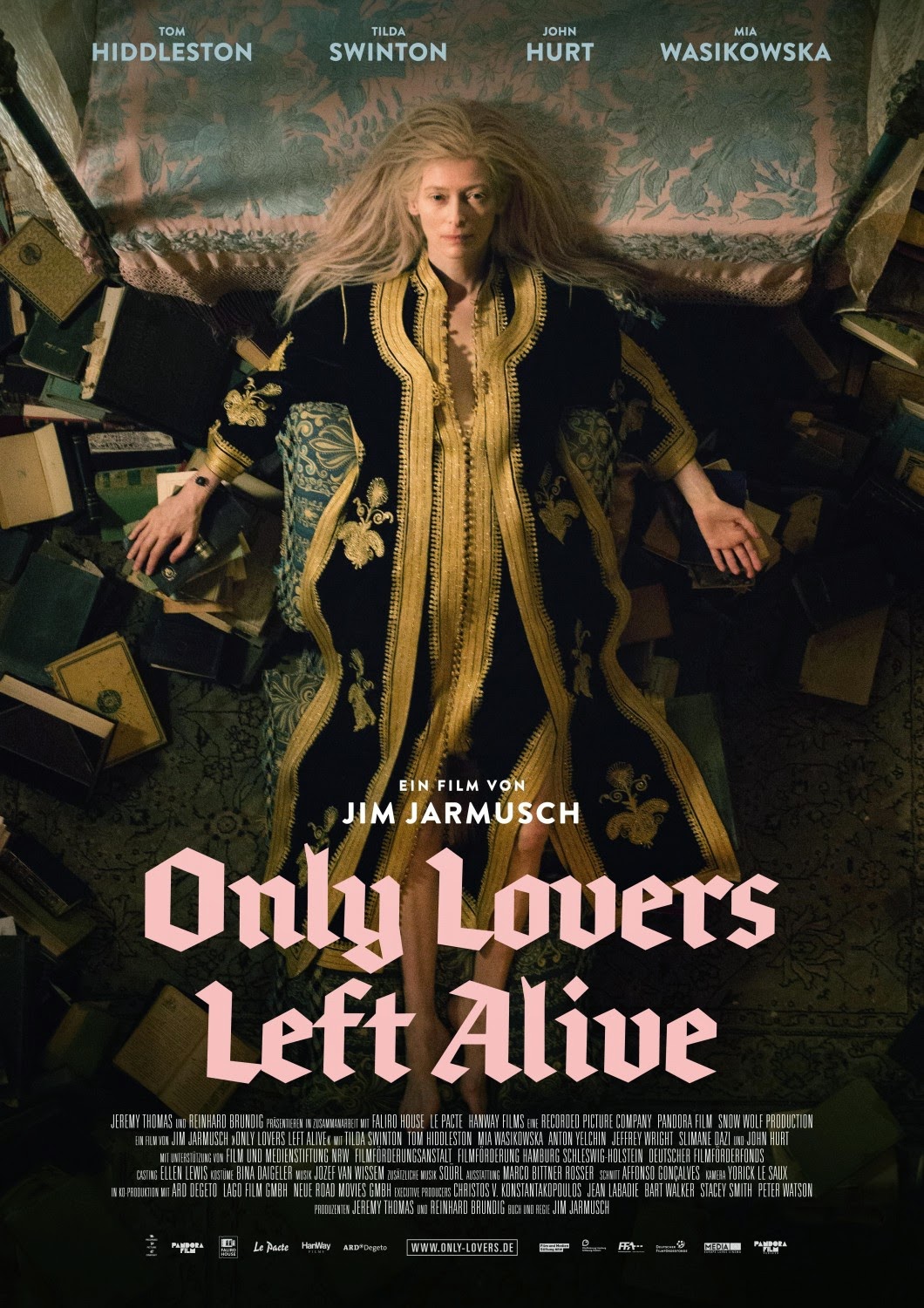
Only Lovers Left Alive (2013)


☆ ☆ ☆ ☆ ½


Only Lovers Left Alive (2013) – J. Jarmusch

With this contemporary vampire film (taking place in Detroit and Tangiers), it feels like Jarmusch has finally created the proper milieu in which to deposit all of his cultural touchstones and references.  His band SQÜRL even contributes some of the minor-key guitar-slab soundtrack music and there are plenty of fetishistic scenes of old guitars (and other equipment), important novels, and celebrity artist photos.  In fact, the film feels like part of a scene – the aging bohemian rocker scene, I guess (and perhaps I belong since I have a couple of White Hills CDs). Tilda Swinton and Tom Hiddleston are the titular lovers still alive as the centuries pass (and there are a fair few references to the damage that we “zombies”, aka humans, are doing to the planet and the culture).  John Hurt definitely looks dead or undead as Christopher Marlowe. Unlike some Jarmusch films this one does have a few discrete plot events that move the story forward or at least break up the flow of arthouse sensations.  But those sensations are assuredly the main point and this is one of Jarmusch’s best films.


Computer Chess (2013)


☆ ☆ ☆ ☆


Computer Chess (2013) – A. Bujalski

The genius of this film is in its smart-ass recreation of a weird period in American history, the very early 1980s when a new breed of computer nerds was programming now-archaic machines to challenge grandmasters (and each other) at chess.  Director Andrew Bujalski has lovingly used period videography (in black and white) to capture the period outfits (bad!), characters (not just nerds but swingers and members of an encounter group) and shabby hotel environs at this low-rent conference/chess match.  I think this is the first “mumblecore” film I’ve seen (I had to google the term) and if you aren’t ready for it, the non-acting, hapless and fragmented dialogue, amateurish production values, and relatively absent plot just might trick you into thinking you are watching the real thing.  Judging by the IMdB, this isn’t too everyone’s taste – but personally I love absurdity.


Friday, 7 March 2014

Frances Ha (2013)


☆ ☆ ☆ ☆

Frances Ha (2012) -- N. Baumbach

I liked it.  Sure, it's a highly stylized character study with lots of montage sequences that have quirky musical overlays (and some dialogue too).  Yes, it's shot in black and white but not beautifully so.  Greta Gerwig (co-writer and director Baumbach's paramour) is in every scene and her goofy personality is over the top, yes -- a lovable loser (but never so embarrassing that you cringe). She's 27 and she doesn't have her act together although many of her peers already have careers.  New York City looks fun, especially if you get to hang out in funky circles with artists and creative professionals (she's a modern dancer but not too successful). But is this real life?  Decidedly not (although there are some real-feeling moments). But Wes Anderson's films aren't either and we don't worry about that.


Monday, 30 December 2013

The Hobbit: The Desolation of Smaug (2013)


☆ ☆ ☆ ☆

The Hobbit:  The Desolation of Smaug (2013) – P. Jackson

A childhood favourite (now preserved at Mom’s house in a green leather-bound volume with runic lettering) called to me and I left the house to see some 3D (good for depth of field, if not for the eyes/head/stomach).  Having been unexpectedly pleased with and drawn into An Unexpected Journey (on home video), I thought Desolation of Smaug would be a fine holiday spellbinder and so it was. Of course, we pick up the story in the middle (after a somewhat disorienting prologue) and we know we will leave it before the end (being the middle part of the trilogy), so this must be borne in mind. That said, with less clear reminders of reading time long past, the film plays as a spectacle, full of orc-killing action, distant NZ mountainscapes, more dizzying 3D fighting, wise old Ian McKellen, a faint echoing of world wars, the darkest evil somehow forged in a ring (that is trotted out somewhat less frequently), and a talking dragon in the form of Benedict Cumberbatch (or is it BC in the form of a dragon?). A roller coaster ride, no doubt, with enchanting visuals (a true alternate reality unfolding before you) and one peak after another. Those who say this second chapter is better than the first may be adrenalin junkies … but how can they (we) go cold turkey for another 12 months?