Friday, 21 September 2018

To Kill A Mockingbird (1962)


☆ ☆ ☆ ☆ ½


To Kill A Mockingbird (1962) – R. Mulligan

I’ve never read the book (by Harper Lee) and perhaps I should.  I suspect it captures the nostalgic feeling of childhood memories of “events of significance” even more than the movie does.  And the movie does a very nice job of showing us a grown-up world through a child’s eyes, a grown-up world where things are unfair and people are treated badly because of the colour of their skin.  It is small-town Alabama in the early 1930s and the children are Scout, a six-year-old girl, and Jem, a ten-year-old boy, and they are the children of grown-up lawyer Atticus Finch, played by a dignified Gregory Peck.  He’s a widower with a deep sense of justice who is called upon (and agrees) to defend black Tom Robinson (Brock Peters) who has been accused of raping a white girl.  Of course, the odds are stacked against them and the racism of the town is such that Robinson needs to be protected from lynching from the same sort of men who are later sitting on the jury.  Yet, we believe in Robinson, and in Finch. as wholeheartedly as his children do, and we see the girl’s father, Bob Ewell, as the true villain, almost an embodiment of evil here.  But the movie is not all serious and we also see the children enjoy themselves, daring each other to run up and touch the door of a spooky nearby house where rumour has it that “Boo” Radley, a shut-in young man (who represents a sort of Bogeyman) lives and who may be dangerous (or perhaps not, since he may be leaving small gifts for the kids).  The plot ultimately weaves a number of different strands together into a satisfying whole, even as it avoids any semblance of a happy ending that would claim to have solved the problem of racism.  Off in the future, from the standpoint of the narrator (a grown-up Scout), these events still seem significant – and the effect of the book and the movie on American society, perhaps more significant still.  Yet, more cultural advances would be needed before we would begin to hear black voices telling their own stories rather than having white advocates speak for them (inside and out of the movies). 

Wednesday, 19 September 2018

Lola (1961)


☆ ☆ ☆ ☆


Lola (1961) – J. Demy

France at the start of the 1960s, not Paris, but Nantes (to the Southwest).  Is director Jacques Demy part of the New Wave? The film, shot by Godard’s DP Raoul Coutard, does have the look, in glorious widescreen black and white.  But Demy dedicated the film to Max Ophuls, master of the longshot in La Ronde (1950), Madame de (1953), and Lola Montes (1955; from which this film gets its name) – did he represent the “tradition of quality” that the New Wave was rebelling against? He was dead before they began (in 1957).  Demy would soon direct the melancholic but glorious The Umbrellas of Cherbourg (1964), which had the actors sing all of the dialogue to the music of Michel Legrand (who also provides the score here in Demy’s first film).  So, Demy followed his own path (as did his wife, Agnes Varda; Cleo from 5 to 7, 1962) and so does this film.  Although the film is titled for Anouk Aimée’s cabaret dancer (very different from her sour wife in Fellini’s 8 ½, 1963), we seem to spend more time with Marc Michel who plays Roland Cassard, a bored and rather aimless young man who meets former childhood friend Lola by accident on the sidewalk and falls in love with her.  However, Lola, a single mum pining for her boyfriend now gone for 7 years, is not interested in Roland nor anyone who might represent a serious commitment (she has a fling with an American sailor instead).  A side-plot or two introduces characters who bear resemblances to the main duo and link with them (or others in the story), a feature that Demy also apparently included _across_ films where these characters may turn up later.  Perhaps the plot goes nowhere – certainly this is the case for Cassard (but not for Lola herself) – but the idling is enjoyable, with a dance number and a potential crime enlivening things.  Apart from the beautiful opening shot, I didn’t register many Ophuls styled long-shots (they may be there), but the film has an ease and grace that reminds one of the master...and simultaneously, the New Wave.


Sunday, 16 September 2018

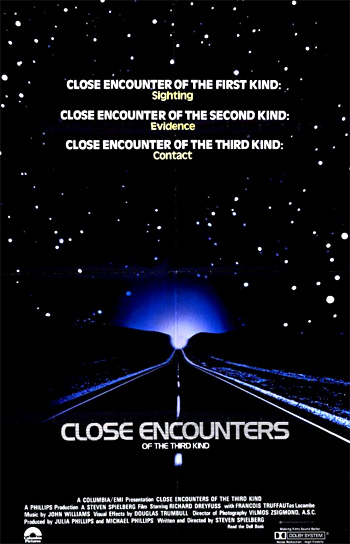
Close Encounters of the Third Kind (1977)


☆ ☆ ☆ ☆ ½


Close Encounters of the Third Kind (1977) – S. Spielberg

Forty years later, Spielberg’s examination of the events leading up to our first encounter with aliens (the third kind = actual contact beyond sightings or discovering physical traces) still retains a sense of child-like wonder at new and amazing things.  In fact, the film impacted me so much when I was a child myself that I ended up taking a pilgrimage to Devils Tower, Wyoming, in the early 1990s – the butte is awesome enough on its own but its association with this film adds an extra weirdness factor that makes it even more compelling.  And, yes, compelling is the operant word here, because the film depicts how, after an encounter of the first kind, a number of humans (including chiefly Richard Dreyfuss and Melinda Dillon) are drawn to this spot where it appears that the aliens will land.  But the film starts a few weeks earlier and shows us how the obsession with aliens takes over the lives of these ordinary people, interspersed with shots of Professor Francois Truffaut’s academic investigation into alien encounters. Of course, the special effects (coordinated by Douglas Trumbull, who had earlier done 2001: A Space Odyssey) are great (and old-school, not CGI) and the five-tone message that unlocks the ability to communicate with the aliens became seared into our brains (although the rest of John Williams’ score is less memorable).  Overall, the film makes you want to believe in (friendly) aliens, even though Spielberg leaves it for viewers to go deeper into the ideas and outcomes introduced here.
  

Friday, 24 August 2018

The Tracker (2002)


☆ ☆ ☆ ☆


The Tracker (2002) – R. de Heer

Not really an allegory, despite the characters being given only labels such as The Tracker, The Fanatic, The Follower, and The Veteran, rather than names.  Instead, the film shows us the relations between a group of white men and Indigenous Australians in 1922 as a sort of microcosm or potent example of the wider relations between the invaders/colonisers and the First Peoples.  And although the prejudice and devaluation are explicit and brutal then, there can be no denying that prejudice and devaluation remain, perhaps institutionalised, perhaps living on in those who miss the White Australia policy. As the Tracker, David Gulpilil has the toughest role and plays it with great subtlety.  We see him assisting the white men (led by Gary Sweet as the Fanatic) who are hunting an Aboriginal man who has been accused of killing a white woman – and of course, we wonder what has led The Tracker to “betray” his people (which in itself is a problematic thought, since we soon can infer that the Tracker is from a different nation).  When the hunters interact with other Indigenous people, The Tracker is in the middle, perhaps feeling guilty or at least awkward.  No doubt there are strong situational forces that have put him into this position.  But after a brutal act (or multiple acts) by the Fanatic, The Tracker (as well as the Follower, Damon Gameau, and the Veteran, Grant Page) begins to distance themselves from him.  The movie continues until the Fugitive is caught and there are a number of dramatic events en route.  However, the plot itself is possibly less important to the impact of the film than other aspects:  1) the impressive landscape (always important in Aboriginal cultures); 2) the music (songs sung by Archie Roach with lyrics that comment on the characters and actions driven by almost psychedelic soulful rock); and 3) artworks (dynamic primitive paintings by Peter Coad are used to avoid presenting violence realistically) heighten the power of the film and its ability to convey its important message.  If only these lessons could be learned. 


Monday, 20 August 2018

Talk to Her (2002)


☆ ☆ ☆ ☆


Talk to Her (2002) – P. Almodóvar

Almodóvar may be an acquired taste – his work can be filled with subtlety and humanistic questioning or it can be broad and outrageous and even crass.  His best work is unpredictable, character-driven, and thought-provoking, even when leavened with comedy. Talk to Her finds Almodóvar in serious mode, following two men who care for women in comas and charting their developing relationship.  He tracks backward to show us events in their lives that led them to their current present day situation (including information that might ordinarily reduce our sympathy – but somehow not here).  Then he allows the narrative to move forward to a somewhat shocking climax (Almodóvar is never one to shy away from melodrama) and a fanciful abrupt denouement.  Along the way, the director includes a surreal “silent film” excerpt that sees a shrinking man climb into a giant vagina.  Well, you can’t be serious all the time. He also shows us the similarities between ballet and bullfighting (copping some flak for emphasising the latter), with a guest role for Geraldine Chaplin as a dance instructor.  Despite the sometimes jarring changes in tone, everything holds together and the resulting feeling is that we have been exposed to real life in all of its sometimes problematic weirdness, sadness and joy. Digging a little deeper, it seems clear that Almodóvar is also raising some questions about male-female relationships where the "perfect" relationship for one man is when the woman is powerless. The powerful woman just happens to be afraid of "snakes" and might be willfully trying to escape a relationship where the man "talks AT her" rather than "to" her . More here than at first glance...


Wednesday, 15 August 2018

Sweet Sixteen (2002)


☆ ☆ ☆ ☆


Sweet Sixteen (2002) – K. Loach

Ken Loach makes social realist films, similar to the Dardennes Brothers from Belgium, but he has been at it for a lot longer (his 1969 film, Kes, is a real tearjerker about a poor boy whose falcon becomes the only thing that makes life worth living).  Jonathan Rosenbaum refers to these films as “social deterministic” and I suppose they do point to poverty and its ill effects as causal factors – or at least constraints – that lead to all the sad and bad outcomes that his characters face.  In Sweet Sixteen, newcomer Martin Compston plays Liam, a teen with an unstable family life in Greenock, Scotland (subtitles are required).  His mum is in prison and her boyfriend is a vicious drug dealer aided by Liam’s own grand-dad.  His sister is estranged from the family and is a single teen mum herself.  After a row, Liam leaves to join his sis and optimistically plans a future where he can live with his mum in a caravan overlooking the scenic River Clyde.  This takes money so he and a friend steal drugs (from his mum’s boyfriend) and begin dealing, eventually catching the eye of the local drug kingpin, who signs them up for bigger things.  Compston’s portrayal of Liam is exhilarating – he is full of energy and laughter and basically fearless, getting into a lot of scrapes and earning a few hard knocks.  However, despite his optimism and positivity about the future, we know that this is not the kind of enterprise that leads to good things and this is not the sort of movie where things work out.  Loach (and screenwriter Paul Laverty, who also co-wrote Loach’s most recent hit, I Daniel Blake, 2016) has a different message to convey.  But he does it with a true affection for his characters and sympathy for their plight and their often fruitless and frustrated attempts to deal with it.


Saturday, 4 August 2018

Accattone (1961)


☆ ☆ ☆ ☆ ½


Accattone (1961) – P. P. Pasolini

Pasolini’s first film as a director; he was previously a poet, writer, and screenwriter; for example, of Fellini’s Nights of Cabiria (1957).  Similar to that earlier film, Accattone focuses on people living on the lower rungs of society’s ladder, but it isn’t quite neo-realism.  Instead, Pasolini’s film has a lyrical and intense quality (and a startling dream sequence) that brings it closer to the films of the arthouse masters (Bergman comes to mind).  Accatone himself (a charismatic Franco Citti) is a scumbag, convincing girls to become prostitutes because he doesn’t want to work himself (his nickname equates to beggar/exploiter/freeloader).  But Pasolini doesn’t want to judge him – he shows us Accatone’s tender side as well as his weaknesses.  We see him try honest physical labour for pay (and give up on it straightaway).  In his context, a bunch of shiftless guys on the street, some thieves, mostly the idle poor, he is the class clown, the butt of all jokes -- and he seems to relish it.  Despite (or because of) the seediness of the milieu and the transgressive acts on display, the film is mesmerizing and probably shocking for its time (although Pasolini would shock even more in his later films).  The cinematography by Tonino Delli Colli is beautiful (though the environs are not); the actors often look straight into the camera offering beautiful portraits for the viewer.  In the end, this heightens our sympathy for those who are barely scraping by (and nevertheless often enjoying themselves) in line with Pasolini’s Marxist philosophy.  A great debut.