Friday, 26 January 2018

Jour de Fete (1949/1964)


☆ ☆ ☆ ☆ ☆

Jour de Fete (1949/1964) – J. Tati

Jacques Tati’s first feature doesn’t star M. Hulot – instead Tati plays a bumbling postman, delivering the mail by trusty bicycle through the quaint French countryside.  The film takes place on the day that the carnival arrives in the small village and before we meet our hero, we see the villagers getting ready for the big day and the carnies arriving and starting to set up.  An old woman with a goat introduces us to the central characters – but as with most Tati films, it matters not a whit what anybody says.  The actions are there for anyone to see and understand – often accentuated with ostentatious sound effects and charming French music.  The sound effects (which play a big role in all Tati’s work) are even funnier once the postman arrives on the scene, ready to engage in some acrobatic slapstick.  The day of the festival moves from feelings  of excited anticipation to the glamour and fun of the event itself (complete with carousel and carnival games) to some rather drunken antics as the evening stretches to night (and the kids are put to sleep).  A pivotal moment involves a short film about how the mail is delivered in America (with helicopters, airplanes, and maybe even bodybuilders), leading not only to shock but to a full next day’s attempt to deliver the mail “American-style” (i.e., as fast as humanly possible).  Of course, this leads to a heap of chuckles and even a belly-laugh or two (especially from Aito, aged 7).  The 1964 version of the film that we watched included some hand-tinted sequences (and Tati apparently added some extra new footage) but Jonathan Rosenbaum tells me that the restored 1994 version in full colour is well worth tracking down.  And I’m sure we will. 

Monday, 22 January 2018

Chimes at Midnight (1965)


☆ ☆ ☆ ☆ ☆

Chimes at Midnight (1965) – O. Welles

The culmination of Orson Welles’ re-visioning of Shakespeare’s plays, after his filming of MacBeth (1948) and Othello (1951) and his many staged versions, including Julius Caesar and something called “Five Kings (Part One)” which was the forerunner for this production. Chimes at Midnight extracts bits and pieces from several of the Bard’s history plays (principally Henry IV, Parts One and Two) in order to focus on the relationship between Sir John Falstaff (played merrily by Welles himself) and Prince Hal (later to be crowned Henry V). And although he filmed in Europe on a low budget, the result is never less than magnificent, with beautiful black and white cinematography, perfect sets and costumes, and fine acting from Welles himself, Sir John Gielgud (Henry IV) and Keith Baxter (Hal) with Margaret Rutherford (Mistress Quickly), Jeanne Moreau (Doll Tearsheet), and Fernando Rey (Worcester) in support, along with a large number of quirky character actors.  If Welles cut-and-paste from footage shot in different times and places (and dubbed his own voice in for others) you can’t really tell (his magic works). As with Othello, existing locations were utilised (including for Henry IV’s stone castle) but a set was built to represent the Inn where Falstaff resides, idling away his time on “sack” (booze) and women and occasionally engaging in highway robbery.  This is where Prince Hal also slums it, to his father’s chagrin.  The centrepiece to the film is an astounding battle sequence, with men in suits of armour hacking away at each other (and Falstaff hiding on the fringes or playing dead).  This is the first glimpse we get of Hal taking on his royal role, as he assists his father to stave off a rebellion by Henry (Hotspur) Percy.  Of course, later, when Henry IV is dead and Hal ascends the throne, the relationship with Falstaff is necessarily quashed, making for a melancholy (but not unexpected) finale.  Welles is perfect in the role, perhaps his best; he hears the chimes indeed. 


Tuesday, 16 January 2018

Filming Othello (1978)


☆ ☆ ☆ ☆

Filming Othello (1978) – O. Welles


Orson Welles’ final film to be released to the public (at least until the soon-to-be-completed The Other Side of the Wind) was a “conversation” about the making of his version of Shakespeare’s Othello, which he shot nearly 30 years earlier.  An essay film in the mould of his excellent F for Fake (1973), it mixes found footage with new material and a great deal of Welles speaking directly to the camera in front of his old moviola (presaging a heartfelt ode to the role of editing in the cinema).  Welles is a charismatic raconteur and a bit of a charlatan and his stories and anecdotes about the past production, itself a miracle of shoe-string budget magic and amazing visual design, held this viewer’s attention rapt.  (Indeed, I actually saw this on the big screen about 15 years ago and despite its central focus on talking heads, it was worth it).  The film breaks neatly into three parts:  1) Welles’ introduction to Othello and his stories about it (shot originally as a preface for a German TV showing of the film); 2) a recording of a luncheon with Michael MacLiammoir and Hilton Edwards, two stars of the film and Welles’ mentors at Dublin’s Gate Theatre, where they talk about the production; and 3) Welles’ vigorous readings of several of the key speeches from the play.  Sounds straightforward but Welles could not help but engage in a little of the trickery that enabled him to make Othello such a success despite being filmed across several years in disparate locations with and without actors and their costumes: apparently, he filmed his contributions to the luncheon with his friends a number of months later and inserted himself into the footage. Best shot:  when he breaks out the wine and they all drink a toast!

Monday, 15 January 2018

Othello (1951 version)


☆ ☆ ☆ ☆ ½


Othello (1951 version) – O. Welles

Although Welles’ Othello puts forth a very serviceable reading of the Bard’s tragedy of jealousy, the real magic here lies in the circumstances of its production and the way that Welles welded together diverse elements (with string and bits of sealing wax) to create an alternate reality that never really existed except in the minds of the viewer.  Shot variously in Morocco, Venice, and other parts of Italy, it would be impossible to create a map that links the various locations together. Yet, miraculously, the film feels whole, in glorious black and white with Welles’ eye for the wondrous shot in fine form.  Of course, it is the editing that keeps the disparate parts together, with shots and counter-shots apparently filmed years apart in different locations, and sometimes the cutting is fast and furious (but never less than astounding).  The acting can be variable (Suzanne Cloutier seems a weak Desdemona – and, apparently, she was dubbed for the 1955 version, re-edited by Welles for the US release) but somehow Welles (as Othello) and Michael MacLiammoir (as Iago) pressed on, even when other members of the cast were absent (and shot with doubles from behind).  If all this sounds like it might distract one from Shakespeare’s words, well, yes and no – the tragedy is still terrible (with Iago cruelly convincing pitiful Othello that innocent Desdemona has cheated on him), even with Welles’ condensing, but the amazing spectacle of the production itself creates the most awe.


Saturday, 30 December 2017

Jules and Jim (1962)


☆ ☆ ☆ ☆ ½


Jules and Jim (1962) – F. Truffaut

The first thing that strikes you about Jules and Jim is the exuberance (joie de vivre?) with which director Francois Truffaut endows the story.  As in his first two films (The 400 Blows, 1959, and Shoot the Piano Player, 1960), Truffaut experiments with film technique, mixing and matching styles in a way that keeps the viewer interested and shows off what Raoul Coutard (cinematographer) could do.  In fact, the first reel, detailing the relationship between best friends Jules and Jim (and the women they loved before they met Catherine) speeds by so fast, with so much cutting between anecdotes, that it is hard to keep up. Part of this may be due to the use of offscreen narration that fleshes out the story and reveals the characters’ inner thoughts and feelings – there are a lot of subtitles to read!  But once Jules (Oskar Werner) and Jim (Henri Serre) meet Catherine (Jeanne Moreau), the film slows a bit to better observe their melodramatic relations across the decades from just before WWI until some years after.  I suppose it comes as no surprise that Truffaut takes the male point of view and treats Catherine and her willful ways as both an object of desire and the cause of suffering; perhaps it is a bit ambivalently sexist but Moreau is nothing if not empowered in the role.  Yet, despite the exuberance, there is a profound melancholy at the core of the film – a yearning for a love that cannot be and perhaps an acknowledgement that it may be difficult for a free spirit to maintain a stable relationship with any one person, let alone two (or three), no matter how strong their passions sometimes are.  Those around them can and do get burned. Ultimately, it isn’t clear whether Truffaut is advocating the sort of compromises that most people make to keep their relationships alive or whether he sides with Catherine’s unfettered approach. Perhaps, as the ending suggests, he knows that some candles burn much too brightly to last.  Fortunately, this jewel of the French New Wave is ours to treasure forever.


Wednesday, 20 December 2017

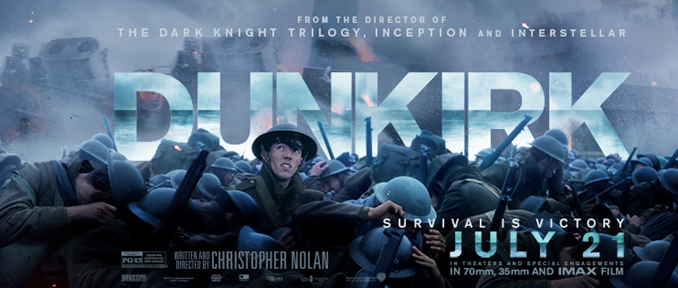
Dunkirk (2017)


☆ ☆ ☆ ☆


Dunkirk (2017) – C. Nolan

I watched Mrs. Miniver (1942) back in July which also features the evacuation of British soldiers from Dunkirk, France, during WWII.  But while the earlier film was a melodramatic piece of wartime propaganda to rally the Allies, Christopher Nolan’s current look back is a visceral “you are there” piece of bravura filmmaking that likely also stokes the patriotic home fires in the Brexit-era UK (or perhaps it is meant to remind them of their bonds with Europe?). No doubt this looked better on the big screen than on the back of the seat in front of me on Qantas Flight 7, but it was still immersive enough. We follow three storylines that intersect at Dunkirk where Allied troops were besieged by the Germans and ultimately evacuated by an armada of private yachts and small boats sailed by civilian volunteers. The storylines are:  1) A couple of nameless soldiers attempt to escape on a first aid vessel (which is promptly sunk) as bombs drop everywhere on the beach; 2) a pair of pilots shoot down enemy bombers, hoping not to run out of fuel; 3) a father and son (and a local boy who joins them) take their small boat to Dunkirk and rescue a shell-shocked airman on the way.  There is very little dialogue, an immense crowd of extras, and a soundtrack that propels everything forward, sounding not unlike the dropping of bombs. I suspect that without the soundtrack, courtesy of Hans Zimmer, this film, like many others, would lose a lot of its impact. That said, the meticulous attention to authentic period detail is truly impressive.  These elements combined make this a film that could (and probably should) be watched again (on a bigger screen).


Thursday, 14 December 2017

La La Land (2016)


☆ ☆ ☆ ☆


La La Land (2016) – D. Chazelle

Definitely evocative of the classic musicals of the 1950s (think Vincente Minnelli) – with a bittersweet flavour that wasn’t really present in the swinging comic 1930s (think Fred Astaire & Ginger Rogers), Damien Chazelle’s third feature knows its history but doesn’t quite transcend it.  Instead, Chazelle plays within the rules of the genre (in which characters can break into song and dance at any given moment) and this has led to some accusations of sexism because the relationship between Sebastian (Ryan Gosling) and Mia (Emma Stone) does evoke 1950s traditional gender roles (and expectations) despite the fact that the leads’ efforts toward developing careers in the entertainment industry (jazz pianist and actor, respectively) are given relatively equal attention.  Although the film opens audaciously with a big number on a highway overpass with a large cast of dancers and then quickly shows us a color-coded sequence featuring Emma Stone and her roommates, things then calm down a bit as Stone and Gosling begin their romance.  That’s not to say that Chazelle doesn’t have a great emotional touch or that his script doesn’t continually hit the right buttons for an homage of this sort, it just doesn’t stay at that high level of surprise/stunningness (nor should it, if the movie is to follow screenwriting 101 norms, which it does).  Gosling is fine, rather subdued and perhaps not much of a singer/dancer (though he taught himself piano for the role) but Stone is very charismatic (if somewhat unusual looking with such large eyes) and together they manage to make their relationship seem real enough with a trajectory that is more-or-less believable.  I say “more-or-less” because in a musical such as this, realism isn’t really necessary, nor even expected; Chazelle gives into the fantasy elements of his script but has the wisdom to underscore the implausibility with the same sort of sadness that you find in Demy’s Umbrellas of Cherbourg (1964).  Again, the thrills found here are not a result of anything new but just a fine example of a master craftsman using the best materials to recreate something that was well-loved from the past (albeit with a new script, songs, and players).