Tuesday, 26 April 2022

Spirited Away (2001)


☆ ☆ ☆ ☆ ☆

Spirited Away (2001) – H. Miyazaki

Is this my favourite Studio Ghibli film? Quite probably (although Totoro certainly could give it a run for its money and I’m not sure I could watch Grave of the Fireflies again to check). This is not the first time I’ve watched it (and assuredly not the last) but each viewing seems to brings new rewards. This time, I had just finished the BFI essay on the film (by Andrew Osmond), which, while not enlightening me too much about any deeper themes, still called attention to certain facets and details which made me a more observant viewer. (I never knew the white god/monster with the red hat was a DAIKON spirit!). Of course, we watched the Japanese version with English subtitles (and Amon sometimes announced that the subtitles were incorrect) – it is interesting to know too that the English dubbed version contains some subtle differences that change some of the readings of the film. If you haven’t seen it, you are really missing out.  The plot (which Miyazaki apparently changed halfway through filming) isn’t necessarily the main point but here it is: a young girl named Chihiro is moving to a new town with her parents; they get lost and find what they think is an abandoned theme park; however when dusk falls, the lights go on and some yummy food appears in the midway; the parents gorge themselves and turn into pigs; Chihiro runs away, meets a young boy who leads her to this amazing multi-story bathhouse where she is employed by sorceress Yubaba who also steals her name (calling her Sen instead); she experiences a lot of challenges in the bathhouse including having to wash a stink monster and she accidentally lets in No Face a voracious and needy spirit who threatens to destroy the entire place; she also needs to rescue the young boy from the beginning who is really a dragon/river spirit in disguise but forced to work for Yubaba against his will.  Anyway, the animation by Miyazaki and his team is both naturalistic and surrealistic (often somehow at the same time), the soundtrack by Joe Hisaishi is plaintive piano music, rising and falling to cue the action and the emotions on display. Indeed, this is a film where emotion is centre stage – we feel for Chihiro: even if the situations she finds herself in are outlandish, the emotions they elicit are real. And it is even possible that Miyazaki’s plot really does contain some oblique takeaway points (about consumer culture/Japan’s bubble years, treatment of women, savaging of the environment/rivers, etc.) – as with all dream-narrative films, the rich imagery and allusions are there for your own interpretation.  Highly recommended!   

Saturday, 9 April 2022

The Bureau (2016; Season 2)


 ☆ ☆ ☆ ☆

The Bureau (2016; Season 2) – E. Rochant

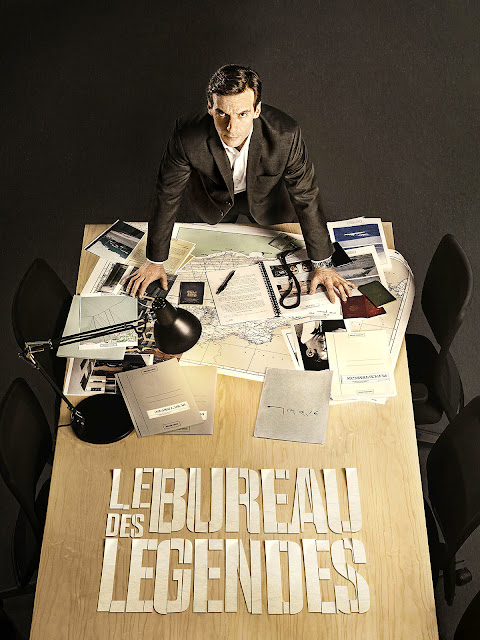
Season 1 closed with enough of a cliffhanger that I needed to move directly to Season 2.  Although the plot-thread involving Cyclone may have (mostly) concluded, a lot of balls were still in the air.  Most notably, we don’t know where Malotru/Debailly’s (Mathieu Kassovitz) loyalties lie and how much he will risk to try to rescue Nadia from the Syrian Secret Service. This second series focuses primarily on Marina Loiseau (Sara Giraudeau), undercover in Iran as a seismologist, trying to find out about the country’s nuclear ambitions. She buddies up with a rich young playboy whose father is involved but he is undoubtedly trouble. A new plot line sees Sisterone working to get close to a French terrorist now with ISIS and responsible for several beheadings. Dangerous stuff.  And of course, Malotru weaves his way through all of the episodes, even as his boss Henri Duflot (Jean-Pierre Darroussin) starts to suspect something is up. For tension and intrigue, this series can’t be beat. I guess I am on to Season 3, as we’ve closed off one or two of the plot threads but Episode 10 concluded with a heart-stopping shocker. You’ll have to start with Season 1, if you’ve just joined us, but Season 2 may be even better.


Sunday, 20 March 2022

Project A (1983)


 ☆ ☆ ☆ ☆

Project A (1983) – J. Chan

Having watched Operation Condor (1991), Jackie Chan’s take on Raiders of the Lost Ark which is all big scale stunts, I thought it might be time to show the boys an earlier film with more hand-to-hand choreographed action. Back in 2011, I wrote the following about Project A:  “Jacky directs and choreographs amazing fights of 20 or more kung fu guys (playing 19th century Hong Kong police/coast guard/pirates) in one of his first big comedy-action hits. Sammo Hung and Yuen Biao, old mates from the Peking Opera School are here as well and their camaraderie shows.  Not sure whether I prefer this series (more kung fu) or the Police Story series (more action) -- both are great for old school (young) Jacky fans!”  Watching with Amon and Aito was fun, especially seeing them laugh uproariously at the opening fight between coast guard and police in a bar and at the subsequent bicycle escape from gangsters. Later, I worried that things got a little too violent (when guns and hand grenades were introduced) and serious (when Jacky quit the force to go rogue) but it’s still all slapstick and stunts and the kids know that it’s all fake and outlandish. This film also contains Chan’s nod to silent comedy star Harold Lloyd’s Safety Last – he dangles from the minute-hand of a clock tower precipitously (but unlike Lloyd, Jackie falls through two awnings to crash to the ground, apparently really injuring himself in the process). An important stepping stone in Jackie’s career and one of his best films.


Saturday, 19 March 2022

The Bureau (2015; Season 1)


 ☆ ☆ ☆ ☆

The Bureau (2015; Season 1) – E. Rochant

I love a good spy yarn (epitomised by those great miniseries featuring Sir Alec Guinness as George Smiley: Tinker, Tailor, Soldier, Spy, 1979; and Smiley’s People, 1982). Those complicated plots, with a harsh light cast on loyalty/disloyalty, truth/falsehood, secrecy/breach, are endlessly appealing. Anyone could be a mole, any mission could come a cropper – and in this compulsively watchable French series, failure is omnipresent. Mathieu Kassovitz plays Guillaume Debailly a.k.a. Malotru a.k.a. Paul Lefevbre who has recently returned to Paris from a six-year undercover operation in Damascus. He may have “alias syndrome”, a difficulty in giving up the freedom of being someone else – this is exacerbated when he accidentally runs into his lover (undercover lover?) from the Damascus days, Nadia el Monsour (Zineb Triki), now in Paris ostensibly involved in cultural exchange (but perhaps something else?). Although distracted, he is required to lead the DGSE (French Intelligence) in their search for an agent (“Cyclone”) who has gone missing in Algeria, possibly abducted, possibly a double agent. These parallel threads (the hunt for Cyclone, the entanglement with Syria) are joined by a third plot strand focused on a new agent, Marina Loiseau (Sara Giraudeau), who goes undercover as a seismology PhD student with the challenge of being selected to join a research team in Iran led by an Iranian professor visiting the Earth Science Institute in Paris. Each of these plots takes a winding and precipitous route through the 10 episodes of this first series – but shockingly only one of them resolves!  Now I’m invested and will have to move on to Season 2 (2016). Absorbing, escapist, filled with great acting and nary a false step.

Nosferatu: A Symphony of Horror (1922)


 ☆ ☆ ☆ ☆ ☆

Nosferatu: A Symphony of Horror (1922) – F. W. Murnau

Gilberto Perez’s essay in The Material Ghost (reprinted in the Eureka blu-ray booklet) has deepened my appreciation of Murnau’s first silent filming of Stoker’s Dracula (with names and other details changed). On previous viewings, I unconsciously interpolated the typical interpretations of the vampire film, not quite realising that Murnau had almost completely removed any sort of erotic theme and much of the plot featuring Lucy and Mina. Instead, Perez suggests that Nosferatu represents death itself and that each character’s reaction to him shows us one way that humans might deal with the knowledge that we are all going to die.  For example, Hutter (Murnau’s name for Jonathan Harker) is happy just to go through life ignoring/denying that death will come; as played by Gustav Wangenheim, he seems rather ridiculous in his wilful neglect of the warnings of the townsfolk and the tome of vampiric legend. His wife, Ellen (Greta Schroeder), is much more anxious and on her guard (as she should be). Knock/Renfield (Alexander Granach) is, of course, driven insane by his thoughts. But, Perez argues, Murnau’s focus was less on one’s personal death and more on the calamity of multiple deaths that resulted recently from WWI and depicted here as the result of Nosferatu’s move from Carpathian outlands to Baltic city, bringing the plague with him. Hard not to think about the current plague, and war, and the growing notifications of deaths of friends or friends’ parents on facebook. However, Nosferatu can also be enjoyed as escapism, a way to distract oneself (from thoughts of death or other things) by observing Murnau’s growing cinematic technique, the location sets, Max Schreck’s ominous rat-like portrayal of Count Orlok (later imitated to good effect by Klaus Kinski in Herzog’s 1979 remake), and the haunting downbeat ending where both Orlok and Ellen die. No answers are provided about what comes next and Murnau offers no salvation in the form of religion or science here. Dark and bleak but mesmerizing.


Tuesday, 25 January 2022

To Have and Have Not (1944)


 ☆ ☆ ☆ ☆

To Have and Have Not (1944) – H. Hawks

On the surface, director Howard Hawks seems to be capitalising on the earlier success of Casablanca by placing Bogie in a very similar role. Here, he plays Harry Morgan, a former smuggler turned charter fishing boat owner working out of Martinique. The French Vichy government (working with/for the Nazis) has taken over but most of the island’s inhabitants are Free French.  Of course, Bogie claims not to be interested in politics and just minding his own business trying to make a buck, but, as before, he can’t help but throw his lot in with the Resistance. But beginning with the Hemingway novel (and with Faulkner as credited screenwriter), Hawks manages to invest the film with his usual theme:  the importance of honour/professionalism/loyalty and the unspoken bond/love between men who work together. Of course, this is also the film where Bogie met Bacall and apparently the script was rewritten to give them ample screentime to show their chemistry – her role isn’t really central to the main action.  Bogie also loves Walter Brennan’s too-far-gone lush (his first mate) and shows real fondness for Marcel Dalio’s bar owner, Frenchy, for whom he agrees to smuggle some people into (and out of) Martinique. It’s a thriller with time for a few musical numbers (courtesy of Hoagy Carmichael and Bacall) and an easy-going classic charm.


Sunday, 16 January 2022

3 Faces (2018)


 ☆ ☆ ☆ ☆

3 Faces (2018) – J. Panahi

On the surface, this is a typically casual and unassuming “film” from Iranian director Jafar Panahi, similar to the others shot during his 20-year ban from filmmaking. Accompanied by actress Behnaz Jafari, he drives from Tehran to the northwest of the country to a small village near the borders of Azerbaijan and Turkey. They are looking for a girl who sent a short video clip purportedly showing her own suicide (because her parents would not let her accept an offer from a famous acting conservatory). It takes a while to get there and then they cannot find the girl.  The locals are friendly and generous and awed by Jafari’s presence (she is popular on TV) but they speak negatively of the missing girl, calling her empty-headed. They also speak negatively of another “entertainer”, an actress from before the Revolution, who was banished and lives alone and poor in the village. Under the surface, and upon further reflection, it seems clear that Panahi is using this opportunity to shine a light on the troubling treatment of women in Iran and to note how the “traditions” (religious and cultural) in regional areas are blocking progress (just as the single-lane road in the village stops all traffic). As usual with Panahi, there are a lot of playful jokes here (for example, we never see the third “face” of the title), including a lot of offscreen action/sound.  The film also serves as an homage to Panahi’s esteemed colleague Abbas Kiarostami (who died in 2016) – all those shots inside the travelling car, journeys up and down hills, the young child who leads them to the girl’s house, etc. Both also shared the skill of expertly blending fiction and reality such that it becomes hard (or pleasurable) to figure out which is which.