Do
you know about writer-director Preston Sturges, one of the masters of screwball
comedy? If not, you are missing out! He
first worked as a screenwriter for Mitchell Leisen (Easy Living, 1937; Remember
the Night, 1940) but then graduated to his own insane work, populated with
peculiarly named characters played by eccentric and memorable character actors
and with a few big name stars thrown in.
His work can be manic and wordy but always funny (and often satirical
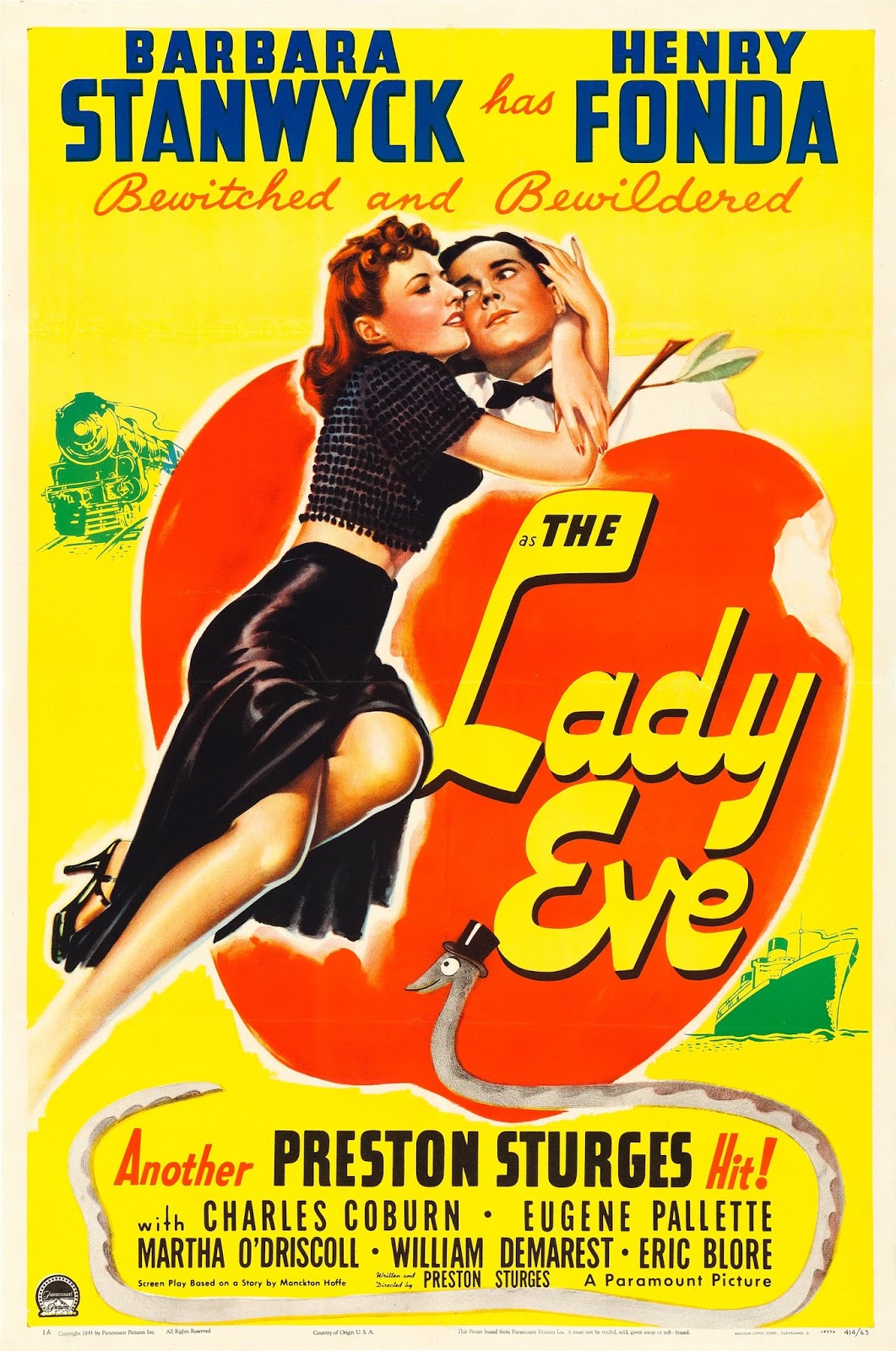
with some bite). The Lady Eve is a
relatively leisurely affair, following Henry Fonda’s Charlie Pike (heir to an
ale fortune) as he encounters a trio of card sharks aiming to swindle him out
of his fortune on a cruise ship. Charles
Coburn (perfect!) and Barbara Stanwyck (exquisite!) team up as a father-daughter
act and Fonda swiftly succumbs to their charms. Stanwyck is soon in love with Fonda too, but
when she’s exposed as the con artist she is, all bets are off! But true to his complicated form, Sturges
doesn’t leave things there but allows Stanwyck to return to wreak her revenge,
lightly disguised as a British noble. Confusion ensues (and lots of pratfalls). The ending is particularly sweet – is this
secretly a comedy of remarriage? Highly recommended!
A flop at the time, Citizen Kane has now
been acknowledged as one of the greatest movies of all time. Orson Welles was a young wunderkind given
carte blanche by RKO to make whatever movie he wanted and he brought his
Mercury Players from New York (where they had triumphed on Broadway and on the
radio, with help from the WPA). Although
the script included extensive contributions from Herman J. Mankiewicz (as
documented by Pauline Kael but disputed by others) and the deep-focus cinematographic
wizardry came courtesy of Gregg Toland, there is no doubting Welles’ imprint as
an auteur. First, the theme of the
egotistical power-hungry man who is also vulnerable, makes mistakes, and comes
to a shoddy end appears more than once in his oeuvre (MacBeth, Mr. Arkadin,
Touch of Evil), alongside the theme of nostalgia for days gone by, one’s youth
and innocence, before those mistakes were made (The Magnificent Ambersons,
Chimes at Midnight, also Touch of Evil).
“Rosebud” represents this latter theme well. Second, Welles’ energy and enthusiasm devoted
to the style of the picture are everywhere to be seen – in Kane we get
thrilling montage after montage, beginning with the faux newsreel and extending
to various ways that time is denoted as passing (those breakfast scenes with first
wife Emily, the Opera sequences with second wife Susan). The camerawork (with long tracking shots),
the sets (with ceilings), the overlapping flashback structure, the ensemble acting
(by Joseph Cotton, Everett Sloane, Dorothy Comingore, Ruth Warrick, Agnes
Moorehead, Ray Collins, George Colouris, and of course, Welles himself in all
sorts of makeup), the chiaroscuro lighting, the baroque excess of it all – these
things make appearances in much of Welles’ future work. He never stopped experimenting (as witnessed
by his late essay films F for Fake and Filming Othello) but it all started
here. Even seen many times, it is still
astonishing to see just how creative the filmmaking was and how much freedom
Welles was granted to do whatever he wanted (freedom he never had again). The rise and fall of Charles Foster Kane,
American, although perhaps a lightly veiled swipe at media tycoon William
Randolph Hearst at the time, still has parallels to larger-than-life
business/politicians today (yes, Donald J. Trump). Some lessons are never learned. Fortunately, Welles’ own story was never
conceived of as a tragic rise and fall by the man himself, who knew that
artistic pleasures were to be gained through the process rather than
necessarily in the end product alone.
However, with Kane, everything came together to produce an incredibly
influential work of art that remains fresh 75 years later.
Not as laugh-out-loud funny as some of
Preston Sturges’ other films of the forties (The Palm Beach Story, The Miracle
of Morgan Creek) but possessed of one of those rare “high concepts” that hits
the spot. In this case, Joel McCrea
plays movie director John L. Sullivan who wants to make a picture about the down-and-out
and their plight (to be called “O Brother Where Art Thou?”) but he realizes
that he hasn’t actually known poverty and trouble himself. So, he decides (in bad taste) to go
undercover as a tramp to see what the life is really like and when he runs into
broke but aspiring actress Veronica Lake, she joins him. It takes a while for
the studio to let him go and a large detachment of personnel – errr, character
actors -- are sent in pursuit if and when trouble does descend. But getting
there is basically all the fun in this film and when McCrea and Lake actually
do meet the destitute, the film gets a bit gloomy. But Sturges pulls us out of it okay, with his
usual ridiculously unbelievable plot mechanics and a grand wink about how no
one really wants message films -- they just want to laugh to forget their
troubles. Amen, brother.
Pretty psychotic in
the "what were they thinking?" vein. Loosely held together slapstick,
oddball comedians, surreal throwaways, and musical numbers. Just when you think
it is waning, something bizarre happens. The Broadway show ran for 1400
performances, but the majority of these performers are long since forgotten.
Hitchcock (always a master
self-plagiarist) here provides shades of Rebecca (1940), a recent hit for him.
So again, we see Joan Fontaine anxious and doubtful of her husband (but this
time she won the Oscar she was earlier denied). Cary Grant plays the charming
cad well enough for us to think that he could be a murderer (which is what
Fontaine eventually suspects – hence the title). Accounts differ as to whether the censors (or
Cary’s backers at the studio) tampered with the ending or whether Hitch wanted
all along to portray a woman’s paranoid fantasies. Indeed, things are mostly ambiguous most of
the time – although we can probably agree that Cary is irresponsible and thus
rather unlikeable. No real MacGuffin
here but a glowing glass of warm milk that may be spiked with an untraceable
poison is a memorable touch. A key plank
in the construction of Hitchcock’s image, if not his best work.
There are moments in this film where the
straightforward telling of the tale suddenly becomes a bit woozy and wobbly and
the supernatural asserts itself. Chalk
this up to the incredible performances offered by Walter Huston (as Mr.
Scratch) and Simone Simon (as his “friend” Belle, from “over the mountain”) –
they have their creepy characterizations down pat. The story itself is one we’ve seen before: a
poor farmer sells his soul to the devil and becomes a greedy uncaring
bastard. His suffering wife has no
choice but to go to the great orator and legislator, Daniel Webster (played
warmly by Edward Arnold, after Thomas Mitchell cracked his head open) to try to
get the contract over-turned. Bernard
Herrmann’s score turns intensely weird at times (and won an Oscar). Did I
tell you the film takes place in New Hampshire? Of course, it champions the
rugged individualism found there but makes a plea for community solidarity too.
An early one from Powell and Pressburger
that is a masterwork in sympathetic propaganda.
And when I say sympathetic I mean to say that they choose not to totally
villainize all Germans but instead choose to make one or two human. In fact, it is the German band of submariners
who escape when their U-boat is destroyed in Hudson Bay, Canada, who we follow
through the film as they escape across Canada.
A lot of British stars waived part of their fees for the war effort to
appear: Laurence Olivier as a French
Canadian trapper (!), Anton Walbrook as the leader of a German Hudderite
settlement, Raymond Massey as an AWOL Canadian soldier, and Leslie Howard as a
British expert on Native Americans camping in the Rockies. Eric Portman plays the dastardly leader of
the Nazi group to evil effect but not without some humanity given his plight. Powell knows that propaganda should only work
(on the intelligent) to the extent that it feels realistic and like it speaks the
truth rather than demonizing and over-doing it.
Message aside, one can already see Michael Powell’s genius as a director
with montage, fades, efficient use of screen time, and nearly surreal moments
of beauty shining through.
What is it about The
Maltese Falcon that makes it so compellingly rewatchable? Is it the original story from Dashiell
Hammett's novel, scripted by first-time director John Huston (who stayed very
faithful to the book)? Perhaps; it
introduced the hard-boiled, pragmatic but honorable private eye to the silver
screen (not withstanding a few earlier less notable versions of the book). Is it Bogart's iconic performance? Probably; his Sam Spade is his most perfectly
realized character yet, setting the tone for a huge swathe of performances to
come. Is it the assortment of unusual
character actors, filling out the minor parts (Peter Lorre, Sydney Greenstreet
and Elisha Cook, Jr. among them, with Mary Astor in a larger role)? Yes; the film would not be the same with
others. Undoubtedly though, the whole
package, with its wicked cynical look at humankind and our pursuit of "the
stuff that dreams are made of", couched in a not-quite-noir (though often
given credit as an early one) mise-en-scene, makes the film fresh each time I watch
it.


.jpg)
