Classic folk-horror
with Christopher Lee as the Lord of Summerisle, off the coast of Scotland,
where the old Pagan traditions are valued. So, there’s a culture clash when
Edward Woodward (as Sargeant Howie), a devout Catholic, shows up to investigate
a missing girl about whom his department has been tipped off. But no one seems to
recollect the missing girl (Rowan) or else they are hiding something! Howie
struggles to understand the locals who have a very free approach to sexuality
that upsets his prudish nature. Moreover, the May-Day festival is soon
approaching and the island is preparing for a big celebration that will include
animal costumes and a parade – plus, as Howie discovers at the library, the
possibility of a virgin (Rowan?) being sacrificed! He is determined to thwart anything horrible
that might occur -- but he is entangled in a mystery that he can’t quite solve.
Director Robin Hardy apparently released a director’s cut that is a bit longer
(and with some scenes in a different order) than the 88 min theatrical cut I
watched. Probably best not to forget that this is a horror film (and the end is
certainly shocking) but the film certainly pushes you to appreciate the old
ways, don’t you think?
Robert Redford is
the petty grifter who makes a big score on the street in 1936 but attracts the
attention of mobster Robert Shaw who promptly arranges for his partner to be
killed. Redford escapes to Chicago to team
up with Paul Newman, an expert in the “big con”, currently washed up. Together, they recruit a team to run a fake
bookie operation to ensnare Shaw.
Director George Roy Hill uses cinematic techniques from the Thirties
(wipes, iris-in or out, slapstick-style chases) and Marvin Hamlisch famously
adapted Scott Joplin rags (“The Entertainer”) for the soundtrack to get that
period feel. At times, with some
over-lapping dialogue and some wistful inter-titles, it almost feels
Altman-esque. The plot twists might even
catch you by surprise (or not – it doesn’t really matter). In sum, The Sting is
good fun.
This
film, a sort of epilogue to (or elegy for) the Nouvelle Vague, captures that
feeling in your twenties when you are finding your way, establishing relationships
under heightened uncertainty, not just about the rules of relationships but
about yourself and your values and goals.
In its typically French fashion, the film is all talk – often fascinating
talk that reveals character (or character flaws), shot with actors speaking
directly to the camera. At the start (of its 3 ½ hour length), the main talker
is Alexandre, played by New Wave stalwart Jean-Pierre Léaud who we know so well
from his work with Truffaut (from The 400 Blows onward). Although he is our main point of
identification, we are likely meant to be ambivalent about him, since he is
clearly setting out to cheat on his live-in girlfriend, Marie (Bernadette
LaFont; her flat, not his) with another woman he notices at an outdoor café/pub,
Veronika (Françoise Lebrun). He is a
charming talker but selfish and narcissistic, even while he aims to be totally
honest with both women (if not always with himself – there is a lot of bad
faith on display here). As the film progresses, we get to see more about Marie’s
perspective (angry, hurt, jealous) and especially that of Veronika who starts
to have monologues of her own by the film’s end -- and she is quite willing to offer
her graphic views on sexual matters, laced with a lot of profanity. Indeed, the film is shocking in this respect,
calling to mind the films of Andy Warhol or John Waters that know no
boundaries. Although not pornographic,
the film does not shy away from presenting the ménage à trois as it appears,
struggles, and collapses, with all the heightened emotions that you would
expect. Given its time period (and the title), it isn’t too difficult to
ascertain that the film has something to say about “women’s liberation” and is
questioning Alexandre’s (and society’s) attitudes toward women and their
role. To its credit, it sees women as free
to make their own decisions about life and especially sex; however, I also got
the sense that director Jean Eustache (who wrote every word) may yearn for
simpler times (or have empathy for those who do) when gender roles were
clearer. The end result is nothing less than completely absorbing and intense
(if dated) – viewers be prepared!
In 1973, Ingmar Bergman created a six-part
TV miniseries (close to 5 hours) depicting a marriage that collapses and the
aftermath. Liv Ullmann and Erland
Josephson play the couple and their acting skill is astounding (especially
Ullmann’s, as she has the wider range of emotions to play). Bergman pulls no punches – this is often raw
and intense and vulnerabilities are exposed.
Anyone in a long-term relationship will have a lot to think about. But yet, the view of relationships seems to
be overtly Bergman’s and the autobiographical nature of these “scenes” is
obvious – he is Josephson’s character (Johan) but he has immense sympathy for
Ullman’s character (Marianne) and the film “takes her side”. You could say that this is because of Bergman’s
own guilt over his series of failed marriages and many concurrent affairs
(including with Ullmann). Naturally, the
characters discuss this guilt and where it comes from and whether it is
justified. They discuss a lot of heavy
things (the film is all talk), perhaps more than in the usual marriage (unless
it is self-destructing), and problems with gender roles are explicitly chewed
over. Johan blames the “women’s lib”
movement and Marianne blames the role stresses that she experiences (mother,
wife, lawyer, daughter). Of course,
Johan is a complete cad – he cheats on Marianne – but he is a painfully honest
cad, breaking up their marriage and explaining in terrible detail why he is
doing so, in a way that can’t help but hurt them both. After this moment, we check in with the
relationship at varying intervals in the future (roughly one, five, and ten years
later). Johan and Marianne have taken
different trajectories (his academic career and his newer relationship are struggling
but she is feeling more and more confident and self-aware). Yet – and this may be Bergman’s fantasy –
they are still close, perhaps still in love, still volatile (able to set each
other off), and impossible to extricate from their relationship. Is this optimistic? Maybe. It _is_ evidence of the way that people can
impact each other, for better or for worse. I am not certain that I “believe”
that this is the way most failed marriages play out (but the emotional moments
in the film always seem to ring true). Bergman edited the 5-hour version down
to 2 ½ for a feature film that played in the US in 1974 (both are in the
blu-ray boxset) – it is possible that the short version would be even more
intense without the natural lulls. Although
Ullmann and Josephson are on screen all of the time, we also see another couple
with a distressed marriage (including Bibi Andersson), Johan’s partner in a
workplace affair, and Marianne’s mother. The interactions with these other characters
offer some counterpoints. I could go on –
there is much to digest. If I’ve scared
you (or the content itself does), let me say that despite the topic/events, the
film is never less than absorbing and can be funny, thrilling, challenging, and
yes distressing, but always worth watching.
It
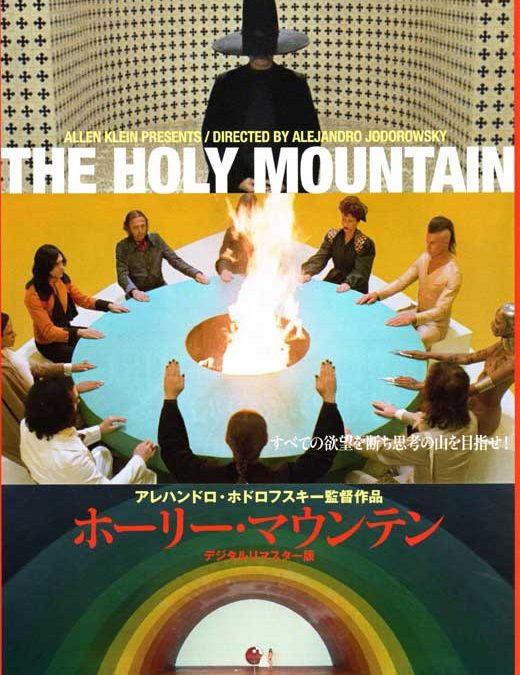
is hard to say whether Jodorowsky is a visionary or a crackpot but it doesn’t
really matter because he is the living embodiment of the artistic impulse, the
desire to channel one’s self and ideas as fully as possible through art
(whether it be film, comic books, theatre, novels, or mime as the case could be
with this man). Certainly, in his earlier
period as a director, he pulled out all the stops, using gratuitous (or
sometimes necessary) nudity and violence alongside spiritual themes and grander
abstract symbols, so many symbols, to create “midnight movies” such as El Topo
(1970). In The Holy Mountain, sometimes
it seems that he is throwing just about everything at the screen to see what
sticks and other times it seems as though there is some meaning lurking in the
varied and bizarre images that appear on screen. (This impression was heightened because I
turned on the subtitles only to find that they were Jodorowsky’s director’s
commentary appearing along with the original soundtrack in English; Jodorowsky
has grown into a wise, gentle, and humorous man who seems to have negotiated
life to attain some real spiritual peace and perspective – he offers some interesting
clarifications!). The plot here seems to
break into three sections. First, we
meet a thief who looks enough like Jesus that some priests make a plaster mould
of him to create some Jesus effigies for sale (no doubt a comment on religion
and materialism and the motives of various churches). The thief meets various Mexican people
(prostitutes as well as priests) and witnesses a toad and chameleon stage show
representing the Conquistadors attack on the Aztecs (warning: these reptiles do
not survive this movie). After the thief
scales a tower and enters a magical land, we begin the second part. The thief meets an alchemist (played by
Jodorowsky himself) who turns shit into gold and bathes the thief in a room that
includes a stunning camel and a frolicking hippo and naked women looking
serious (or having their heads shaved).
The extremely fashionable alchemist invites the thief to join him on a
quest to the Holy Mountain with 7 other people, introduced in turn, who
represent the planets (with astrological meanings). Some of their meeting takes place in a room
with huge paintings of Jodorowsky’s own tarot deck, but later they are seated at
a table shaped like an eye (when seen from above) with a fire pit in the
center. Once they have abandoned their
material possessions, the third part, the trek to the mountain begins -- and
the cinematography changes entirely, as Jodorowky and his team head out to
really climb a mountain. No more
stylized sets and freaky set-pieces; now we are ready for spiritual
ascension. At the top, are the universe’s
rulers, who are to be replaced by our new nine – or not! The film ends with an abrupt joke! We are thrown back to reality, presumably
changed by the very strange trip that Jodorowsky has taken us on. So, ultimately, your mileage may vary: there may
be some real symbols and archetypal themes embedded in the film or it might all
just be the hallucinatory ravings of an avowed surrealist (who, like Bunuel,
takes potshots at society’s main institutions along the way). At any rate, it is very often a wonder to
behold and the soundtrack (with contributions from Don Cherry) is the perfect
accompaniment. For the open-minded and
not for those easily offended or shocked.
It was a dark and stormy night, so we
watched this horror classic again (the version you’ve never seen from 2000 with
extra footage restored by the writer, Blatty, and director, Friedkin). Of course, it has lost some of its ability to
shock after repeated viewings but it still isn’t too hard for me to return
mentally to that moment when I stumbled into a dorm lounge at William &
Mary where some students were watching this in the dark (its reputation had preceded
it and I was totally freaked out). Although probably responsible (to some degree)
for the shift from the subtle implication school of horror that left most to
the imagination (i.e., Val Lewton productions) to the no-holds-barred explicit
approach of showing it all with special effects, Friedkin and team do introduce
the horrifying supernatural events with a reasonably slow build up. For example, you may have forgotten the
prologue that takes place in northern Iraq showing Father Merrin (Max von
Sydow) uncovering an ancient demonic artefact during an archaeological dig. Then, the switch to Georgetown in Washington
DC introduces us to actress Chris MacNeil (Ellen Burstyn) and her daughter
Regan (Linda Blair) who seem perfectly normal (although part of a “broken”
family: the first suggestion of the devil’s work or the potential cause of
Regan’s later breakdown). Only a short
scene with a Ouija board that Regan uses to ask questions of “Captain Howdy”
hints at the horror to come. A parallel
plot thread introduces us to Father Damien Karras (Jason Miller), a Jesuit priest and
psychiatrist, who is trying to look after his elderly mother from a distance
(she is in NYC and he is in DC) and simultaneously suffering a spiritual crisis
– he feels that he is losing his faith.
As Regan’s behaviour gradually begins to change (after her bed starts
shaking), she is treated to an increasing array of medical tests (some very
invasive) before the doctors turn, first to psychiatry, and then to
religion. Cue Father Karras and later
Father Merrin (freshly returned from the Middle East). A related murder brings Detective Kinderman
(Lee J. Cobb) onto the scene but all signs point to Regan and demonic
possession (and those steps down to M Street).
You know the rest. The funny
thing about The Exorcist is that, despite its head-spinning and projectile
vomiting and impossibly filthy language and obscene actions produced by a
12-year old girl (with the voice of chain-smoking Mercedes McCambridge), this
is really a film that champions faith and conservative family values. Indeed, its arrival in 1973, when the earlier
Summer of Love values had been tainted by Altamount, Manson, Vietnam, and the
encroaching Nixon scandal, seemed to both echo the problems of the times and
also try to claw back some order in the shape of a religious force for good
that could exorcise the demons and the horror that they were perpetrating. So, there are deeper tectonic plates upon
which the film’s crasser surface elements are sliding which may help to explain
its lasting power. If you choose to
suspend your disbelief (and the book and film _were_ based on true events),
then this could certainly freak you out big time.
Now that I’ve read Raymond Chandler’s
original novel, I can see the liberties that screenwriter Leigh Brackett (who
also adapted Chandler’s The Big Sleep in the 1940s) took with the
material. Naturally, she had to reduce the
plot and eliminate secondary characters, not to mention adapting everything to
fit director Robert Altman’s conceptualization of the film as showing a 1950s
Philip Marlowe trying to operate in early 1970s L. A.. But she also changed the
ending, giving it more of a punchline.
Having seen the film many times over the years, I wasn’t prepared for
how much richer the novel would actually be (and I anticipated an ending that
wasn’t really there). Yet, for all that,
Altman’s film functions as a work of art all on its own. For one, he applies his “high concept” to
create a disjunction between the P. I.’s no nonsense behaviour and expectations
and the actions of the me generation all around him. Altman also uses his usual idiosyncratic techniques
(improvisation by the actors, overlapping dialogue, a restless camera that
often zooms) to further disconnect this version of Chandler from the films noir
of the 1940s. Vilmos Zsigmond’s colour cinematography,
utilising his “flashing” technique to reduce contrast, also takes the look of
the film away from that earlier canon – it feels 70s (and a muscle-bound Schwarzenegger
cameo adds to the effect). Despite all
this, Elliott Gould’s Marlowe rings true.
In the book, he’s also a smartass, unafraid to use sarcasm with all the
wrong people, quick with the one-liner; he doesn’t avoid trouble and he always
plays it straight up. Sterling Hayden
(with his excellent noir pedigree) is also note perfect as raging alcoholic novelist
Roger Wade; however, his role is much diminished compared to the book. But leaving the book aside (regardless of the
fresh insights it provides into the movie), another highlight of Altman’s
telling is the music. He takes a schmaltzy
song written by John Williams and Johnny Mercer (“The Long Goodbye”) and fills
the soundtrack with it, having it played by every diegetic device (car radio,
lounge bar pianist, Mexican marching band, even a doorbell) and all over the
soundtrack in different versions by different singers/musicians. This adds to the “experimental” feeling of
the film. But the overall effect is “loose”
and a swell homage to noir and to sunny California.
I might be tempted to call this
exhilarating Senegalese film “psychedelic” (because of all the non-diegetic
sound and eclectic music) but probably it is really taking its cues from the
French New Wave. Djibril Diop Mambety
(who wrote and directed) is very free-spirited with the narrative, which sees
two lovers aspiring to escape Dakar for their idealized version of Paris, often
pausing to show us the African backdrop of people, shantytowns, and ocean
vistas. Most likely, there is symbolism
here that I’m missing (the early slaughter of the cow that is related somehow
to the horns on the motorbike that serves ultimately to distract Mory from his
journey to France, for example). But you
do get a feeling that this is what Dakar really was like in 1973 and perhaps
the film makes it seem exotic enough that you wonder why Mory and Anta would
want to leave (except of course for the way they are treated as
outcasts/misfits and the general poverty all around) – but so it goes even
today. Yet somehow the film feels
uplifting.
The second film in Kinji Fukasaku’s
yakuza series is just as good as the first (Battles without Honor and
Humanity), although it takes place on a smaller scale and with fewer central
characters. Bunta Sugawara is back from
the first film but he stays on the sidelines here, present apparently only to
lend some continuity to the proceedings.
In prison, Shozo Hirono (Bunta) meets small time hood Shoji Yamanaka
(Kin’ya Kitaoji) who then takes center stage when he becomes a gun man for the
Muraoka family and falls in love with the boss’s niece. All seems to be going well until a rival gang
led by insane Katsutoshi Otomo (played intensely by Sonny Chiba in one of his
last films before international stardom as The Streetfighter) declares war on
Muraoka. Yamanaka is a pawn in the
proceedings and willingly goes to jail for the family…but then the betrayals
begin. Bloody, chaotic, and with a
hyperventilating lead performance from Kitaoji, the film keeps the tension
cranked (but it is consequently less Shakespearean than its predecessor). Not
for the squeamish.
Battles
Without Honor and Humanity (1973) – K. Fukasaku
One of the key Yakuza films that sought
to shatter the myth of chivalrous behaviour amongst gangsters that had
heretofore been portrayed in film and to replace it with its opposite: betrayal,
paranoia, greed, and, yes, a lack of honor and humanity. This was the first big hit for director Kinji
Fukasaku (later famous in his old age for Battle Royale) and star Bunta
Sugawara and it spawned four sequels.
Not surprisingly, the film is extremely bloody and brutal, as we follow
the Yamamori family’s birth, rise, and eventual splintering. Nothing is glamourized: from the early days
of the post-WWII black market to the later days of entrepreneurial business
ventures jointly operated with politicians, central characters are just as
likely to get rubbed out by a backstabbing surprise attack. Although, at first, I thought I might get
lost trying to identify the myriad sub-bosses, eventually I was able to grasp
the various players and the Shakespearian machinations of the plot (thanks also
to the subtitled announcements of each character’s death, accompanied by a
fanfare of trumpets). Gritty, violent, not for all tastes, but a touchstone in
this genre.
Gently surreal, as
perhaps all films shot in Spain are required to be. This one takes place in the early 1940s, far
away from civilization, where a travelling cinema brings fantastic
entertainment to adults and children alike.
For two small girls, James Whale's Frankenstein is a dramatic experience
beyond those that children are expected to have; its impact on them returned me
back to the days of the monster under the bed and Dracula hiding in the
closet. But the film is lightly fried,
not nostalgic, not horror, just rich with sublimely observed anecdotes and the
power of images.
If you looked (back)
at a life from say the end of high school up until age 30 and just tried to
capture the "most important" events -- or at least tried to report
how these were remembered, even if it was just, you know, a single image or a
conversation of 1 or 2 minutes, what would that look like? If you edited these memories together to
create a 90 minute film, would it be a coherent narrative? Would it pack an emotional punch? Would it yield
"illumination"? Stanislaw
Latallo chooses to study physics and subsequently pursues an advanced degree,
suspends, works in a mental hospital (with neurosurgical treatments), has
romances, gets married, has a kid, returns to his degree (amazingly) and so
on. So, this might resonate more if
you've considered science (or further study of any kind). Also, if you are ready to engage with a more
experimental storytelling style, in Polish (by Zanussi).
Edward Woodward is a
deeply religious (Christian) cop who is called upon to investigate the
disappearance and possible murder of a young girl on the Scottish island of
Summerisle. What he finds there deeply
conflicts with his values and views -- a thriving community of pagans led by
none other than Christopher Lee (in a great performance). Although somewhat cheesy at times, the movie
doesn't hold back and shows the members of this rural farming community (in
real Scottish locales) really honoring the rituals of the ancient past (for
example, at one point, a teacher exclaims to her young pupils that the may day
pole is like a giant penis symbolizing the fertilization of the land). To say
more about Woodward's quest would spoil the fun, but the movie does tilt into horror
by the end.
I don't know how real
movies are made but I love watching movies about movie-making. The challenges of moving from
concept/idea/script to its practical realization in front of the camera is
endlessly fascinating and, of course, movies in this tradition are always
focused on the troubles that ensue.
Whereas Fellini's 8 1/2 sees the director stuck for ideas, Truffaut's
more minor (but still endearing) work shows the director trying to hold a
motley cast and crew together while they over-react to relationship dramas on
the sidelines and downgrade (or upgrade) their expectations about what kind of
film is going to be accomplished. The
moneymen are barely kept at bay. Truffaut brings a lot of anecdotes from his
own career to the table (e.g., working with a cat) and also pays tribute to
some of his favorite filmmakers. Similar in some ways to Richard Rush's The
Stuntman (1980) although with a much more sedate director (played by Truffaut
himself), this is an affectionate depiction of the passion that is required to
get a movie made.
Made for German TV in
1973, this is Rainer Werner Fassbinder's only sci fi effort (among 40 or so
films made before he died in his thirties in 1982). Shot quickly on a small budget but with a
hell of a lot of flair and style (just look at how the camera moves and what it
looks at). It even feels like a 70s
action show at times but it is deeper, more layered, more existential, and a
lot more nutty than that. Best watched
across two nights (it was designed in two parts) to really let the "shattering"
cliffhanger set in -- I was really looking forward to the second half. To top it all off, this 40 year old film is
so "modern" with its focus on the creation of a virtual reality and
how the electronic beings in it might take on consciousness (and what might
happen then). The ending might knock you
for a loop!