Tuesday, 14 April 2020

The Farewell (2019)


☆ ☆ ☆ ☆


The Farewell (2019) – L. Wang

I don’t know much about Awkwafina (she’s also a rapper?) but she has an easy-going charm that helps to carry this film by new director Lulu Wang.  The story is personal but it references cultural differences that likely affect most migrants, particularly those crossing from East to West (or vice versa).  For example, the rights and duties of families versus individuals may be very different (this is practically a cliché by now, of course).  This traditional conflict comes to a head when the grandmother of Billi (Awkwafina) is diagnosed with Stage 4 cancer back in China and the family decides not to tell her -- with the complicity of the hospital.  Having grown up in New York, Billi is stunned by what she perceives to be the lack of dignity afforded to her grandmother but her family maintains that it is their responsibility to bear the emotional weight of the situation and to protect “Nai Nai” from its stresses.  That’s the plot in a nutshell and the screen time is used primarily to flesh out the family dynamics:  everyone has returned to China for a (faux) wedding between Billi’s cousin and his Japanese girlfriend which is really an excuse to see Nai Nai one last time.  The mix of drama and comic relief is deft and the music (by Wang herself on piano) helps to guide our emotional responses.  It’s an easy film to like despite its heavy theme – perhaps the universality of the events and the contemplation of different ways of responding to them across cultures provides an access point, regardless of one’s origin.  Awkwafina (aged 30 here) might also attract Millenials who are shaping up to be a very amusing generation. 


Sunday, 5 April 2020

The Manchurian Candidate (1962)


☆ ☆ ☆ ☆ ☆

The Manchurian Candidate (1962) – J. Frankenheimer

I think it was probably 1990 or so when Bill, Marc, and I all travelled to Chicago (from our separate locales) to visit Laura.  There was a Jackie Chan film festival at the Art Institute (this is how I remember it) and we planned to see something – but, somehow, we turned up on the wrong night and The Manchurian Candidate was showing after having been out of circulation for decades.  What a thrill to see something this weird with no foreknowledge!  Frank Sinatra stars as Major Ben Marco who, as the film opens, is captured with his platoon by Chinese troops in the Korean war.  In a tour-de-force scene (staged by director John Frankenheimer), we learn that they have been brainwashed into believing that they are waiting out a storm at a women’s garden club meeting in New Jersey when in fact they are exhibits of psychological conditioning being shown to Chinese and Russian brass.  Laurence Harvey plays Staff Sgt. Raymond Shaw who is conditioned to be an assassin and set to be turned over to his American operator upon his return to New York. Being asked to play solitaire –and the presence of a particular card -- are the cues that open him up to external control. When Marco starts having vivid nightmares about his time in Korea, he begins an investigation that will ultimately lead to the truth.  Angela Lansbury plays Shaw’s mother, a rabid anti-communist working through her buffoon husband (Barney Miller’s James Gregory) who is a McCarthyite senator. Janet Leigh plays Sinatra’s love interest – or is she a double agent? Their dialogue together is nonsensical at best.  The plot has a number of twists and turns, which I won’t reveal here.  (I refuse to watch the remake).  This is one of the all-time great Cold War thrillers – if you haven’t seen it, you should. 


Sunday, 29 March 2020

Stalag 17 (1953)


☆ ☆ ☆ ☆


Stalag 17 (1953) – B. Wilder

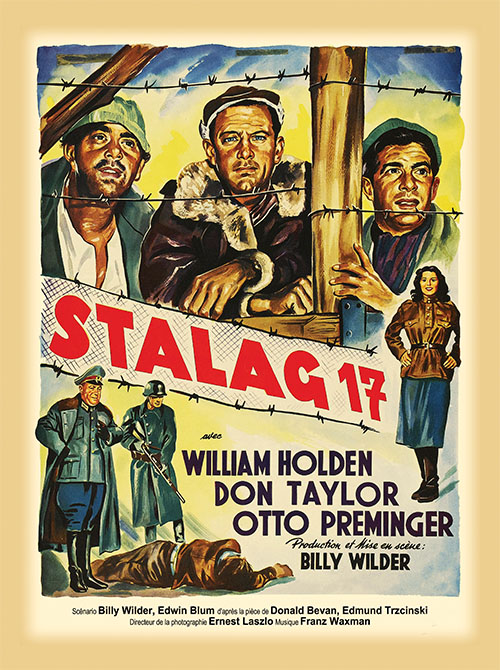
Billy Wilder’s Stalag 17 really has little resemblance to Hogan’s Heroes, the television show which followed it twelve years later.  Sure, they are both comedies set in POW camps during WWII (and both have a buffoonish Sgt. Schultz) but William Holden’s Sefton is about as far as you can get from Bob Crane’s Hogan.  For one thing, Sefton is not a sympathetic character – he’s more of a misanthropic grifter – and the other men do not look up to him (although he does run the still, organises gambling, and other illicit activities).  In fact, the plot of the movie focuses on the presence of a spy in the barracks, feeding information to the camp Commandant (played campily by Otto Preminger, a director in his own right), and everyone suspects Sefton.  There are a few distinctive characters in the barracks, principally Shapiro (Harvey Lembeck) and Animal (Robert Strauss) who clown around and Joey (Robinson Stone) who has been traumatised into a stupor.  As this suggests, the blend of humour and darkness can create an uneasy tension (wry cynicism is a Wilder trademark), although shenanigans and the team effort to defy the Nazis keeps bleakness at bay.  If you’ve only ever watched the TV series, you really should give the film a look.


Sunday, 22 March 2020

Princess Mononoke (1997)


☆ ☆ ☆ ☆ ½


Princess Mononoke (1997) – H. Miyazaki

Miyazaki’s strengths lie in his fierce imagination and beautiful images aligned with environmental and humanistic themes.  His movies possess an internal logic all their own – and they might not always “make sense” outside of their own context.  But somehow the events still carry astonishing emotional weight, carried by the swelling sentimental music (by Joe Hisaishi) and allusions to the real world.  For example, much of the impact of Princess Mononoke lies in the idea that humans are destroying the environment, even though the story takes place in a fantasy version of feudal Japan where giant animal gods still roam the Earth despite the spread of humans.  We can be sad for the forest (whose health is symbolised by strange little sprite-like creatures) although we identify as human, understanding as Miyazaki’s heroes do, that we must learn to live together with nature.  But many humans in the film have not come to this realisation – and Miyazaki still asks us to empathise with the men and women of the ironworks who make the guns that are used to kill (forest gods as well as the pillaging samurai).  The central hero is Ashitaka who is infected by a boar god turned demon and must travel west to undo the curse – it is there that he finds himself in the middle of the battle between San and the wolves (who represent the forest) and Lady Eboshi and the ironworks (who represent human civilisation).  He tries to help them both – a complex position for a protagonist, demonstrating clearly that Miyazaki isn’t interested in making things easy for viewers (just as the issues are not easy in reality).  In the end, of course, it is the images, strange, gruesome, beautiful, violent, be they creatures, landscapes, or something more abstract, that will retain a grip on your memory, as they do in most Studio Ghibli films – and not the plot.  For what it is worth, I watched the Japanese version with subtitles (but not Neil Gaiman’s version).


Saturday, 14 March 2020

Ad Astra (2019)


☆ ☆ ☆ ☆


Ad Astra (2019) – J. Gray

Moody, meditative, even melancholy science fiction that stars Brad Pitt as an astronaut following in the footsteps of a famous father (Tommy Lee Jones in a cameo) and reflecting on the man and his (psychological) influence.  There’s more to it than that, of course, but not much more – this is minimalist filmmaking (from director James Gray) that aims to hypnotise viewers (and succeeds).  Pitt provides a restrained internal performance that seems most unbelievable when he awakens emotionally to the events around him. Basically, he is co-opted into the search for his father who disappeared decades ago but may now be threatening the Earth from somewhere out beyond Neptune.  Major McBride (Pitt) is torn between his admiration for his father and his sense of duty to the Space Force. As with Tarkovsky’s Solaris (1973), ruminations about relationships (this time, father-son relations) are dressed up with a matter-of-fact look at life in the future (commercial flights to a tourist trap moon, not far from a warzone over mining rights) and some dreamy visuals.  Plus a few action sequences to spruce things up. Perhaps the ending (apparently foisted on the director) doesn’t quite fit, given the trauma experienced by McBride (across a lifetime) but Pitt makes a noble effort with the lines.  Worth a look, if you’re on this wavelength.


Tuesday, 3 March 2020

Rumble Fish (1983)


☆ ☆ ☆ ☆


Rumble Fish (1983) – F. F. Coppola

As a fully impressionistic picture that lets style dominate substance, Rumble Fish works.  It’s evocative of a time and place (where and when are not clear) and a social dynamic – the young tough kids (possibly from broken homes) who want to belong (to a gang) and want to follow a leader and the trouble they get into.  I was surprised at how Coppola went full art-house here but I suppose this is only four years after Apocalypse Now which certainly was a high watermark for stylish indulgence.  In this film, the B&W cinematography is beautiful, as are the players it records (Matt Dillon, Diane Lane, Nicolas Cage, Mickey Rourke) and there are plenty of dramatic set-pieces, plenty of amazing shots. Tom Waits and Dennis Hopper drop by to be photographed (in character, their characters). Sure, the plot doesn’t quite add up – we don’t really get to understand why all the kids look up to Motorcycle Boy (Rourke) or why the adults (and he himself) think he is insane – but as a series of moments that create a sensual feeling (perhaps for Coppola, a nostalgic feeling), it did it for me.  Perhaps you have to be in the right mood, ready for the mood it creates, ready to follow Matt Dillon’s emptiness yearning to be filled, ready to be perplexed at his adoration of Mickey Rourke, wishing he did right by Diane Lane.  I just let it wash over me. 


Sunday, 2 February 2020

The Lighthouse (2019)


☆ ☆ ☆ ☆ ½


The Lighthouse (2019) – R. Eggers

Robert Eggers’ follow-up to The Witch (2015) is a must-see just for its incredible craftmanship alone, not to mention the passion and intensity that all involved seem to have put into it.  Whereas The Witch took us very realistically back to the 1630s, The Lighthouse is set in 1890 (and iMDb suggests his next film is a 10th century Viking revenge film!!!).  Again in impressive black and white (with Oscar nominated cinematography by Jarin Blaschke) using old lenses/equipment that required blazing lights and still resulted in a very dark look -- in line with the dark themes.  Robert Pattinson and Willem Dafoe play lighthouse keepers (or “wickies”) who serve their time on an isolated off-shore rock in rotating month-long shifts.  Only the seagulls (which Dafoe’s salty old seafarer calls the souls of departed seamen) are there to keep them company or to act as adversaries even.  Whereas Dafoe’s Thomas Wake is used to the job, Pattinson (playing E. Winslow) is a first-timer and we basically take his point-of-view, which may be unreliable, as he learns the ropes and starts to wonder whether Wake is keeping secrets from him.  As could be expected, the isolation starts to have ill effects on Winslow’s mind and his relationship with Wake.  The two actors, basically the only players here, fully commit to their roles which require some extreme actions – and I think we can agree that Pattinson and Dafoe are the right actors for this journey.  Of course, the look of the film is incredible, with its period detail, clothes, sets, and so on, but the dialogue itself is also drawn from period sources and Dafoe in particular dishes up some amazing monologues.  Eggers even fashioned designed some shots after old paintings.  Of course, it all leads up to the mystery of the light itself, which has some Lovecraftian aspects.  Gruelling but humorous and absorbing and highly recommended!