Showing posts with label 1953. Show all posts

Sunday, 14 June 2026

The Wages of Fear (1953)


☆ ☆ ☆ ☆ ½

The Wages of Fear (1953) – H.-G. Clouzot

Nail-biting suspense here, although director Henri-Georges Clouzot takes his time to develop the characters and their desperate straits before really getting stuck into the action.  Yves Montand plays Mario, one of a group of expats stranded in a poverty-stricken South American village, doing odd jobs to get by, but mostly leeching off his friend Luigi (Folco Lulli) and messing around with barmaid Linda (Vera Clouzot).  When older gangster-type Jo (Charles Vanel) shows up looking to make money, he makes contact with the American oil company drilling in the area, looking for an angle.  Nothing doing, so he parks himself at the local saloon and riles up the other expats as their frustrations mount.  Then comes news that one of the oil rigs has caught on fire; the Americans need to get some nitroglycerine to the site to stop the burning. To save money, they decide not to wait for safer modes of transport and offer $2K to anyone willing to drive ordinary trucks loaded with nitro across rough terrain for 300 miles. The danger is high, but the men are desperate.  Mario, Jo, Luigi, and Bimba (Peter van Eyck) sign up and commandeer two trucks that leave at dawn, spaced 30 minutes apart.  The rest of the 156 min film is the tense journey, the obstacles along the way, the interpersonal disputes, the stoicism, the fear, the mishaps (if that word can be used for this sort of disaster).  Like many a noir or heist film, The Wages of Fear is a procedural with the characters taking stock of each new problem (for example, a huge boulder stuck in the path) and devising a solution to get beyond it. All the while, the trucks are poised to blow up with the slightest wrong move.  Grand Prix winner at the Cannes Film Festival that year (before the Palm d’Or was introduced as an award in 1955).

Sunday, 10 December 2023

Ugetsu (1953)

☆ ☆ ☆ ☆ ☆

Ugetsu (1953) – K. Mizoguchi

Mizoguchi doesn’t pull his punches. So even though he is recounting a ghost story (as one of two interwoven tales), we are still treated to a look at the brutal conditions of feudal Japan in the 16th century. In particular, he shows us the awful fate of women – here the wives of the two protagonists (Kinuyo Tanaka and Mitsuko Mito) suffer either sexual violence or murder (you are forewarned). Things are barely better for Genjurô (Masayuki Mori) and Tôbei (Eitarô Ozawa).  Both are farmers but Genjurô has a side-line in pottery, using a hut-sized kiln to forge sake cups, jugs, and bowls. As war breaks out among the Samurai clans, they decide to sell their wares in the nearest town, discovering profits to be had. Tôbei longs to become a samurai himself and uses his share of the proceeds to buy some armor. Genjurô is seduced by a noble woman (Machiko Kyô), after delivering her purchases to her expansive but decaying manor.  Both neglect their wives, who suffer the fates described above. As the two tales unfold, our heroes find different fortunes – both transcending what could be expected from your standard reality (although Genjurô’s tale is clearly the more supernatural). Perhaps the censors (American) required Mizoguchi to tack on an unlikely “happy” ending but there is no escaping the downbeat nature of these tales of moon and rain.  (Sansho the Bailiff, 1954, would go even further into the horror of the times, with no relief). As a jidaigeki (period film), Ugetsu’s mise-en-scene and art direction are top notch – no sign of 1950s Japan anywhere and thus, we are transported to another time and land, where real and unreal mix.  


Tuesday, 2 May 2023

Anatahan (1953)


 ☆ ☆ ☆ ☆

Anatahan (1953) – J. von Sternberg

I believe it is only a coincidence that I’ve watched two movies featuring people stranded on deserted islands this month. First, Lord of the Flies (1963) and now Anatahan (1953). Although similar in the predicament of the protagonists (young boys after a plane crash vs. Japanese soldiers after their boat sank) and in their inevitable descent from civilized to instinctual, the films otherwise are very different. Brook’s film strove for realism with the boys actually filmed in Puerto Rico on real beaches and in the tropical jungle whereas Anatahan, which was Josef von Sternberg’s final film, is as artificial as they come but stunningly so. In his earlier career, with Marlene Dietrich as his muse, Sternberg was already a master of cinematography, working with light and sets in an Expressionistic way. Anatahan was filmed decades later on a soundstage in Kyoto with nary a beach or jungle in sight; instead, foliage was constructed from paper and cellophane with the Kabuki-trained actors front-and-center in the clearly unreal settings, dappled with light and shadow.  Even weirder, Sternberg does not translate any of the Japanese spoken dialogue but provides a voice-over narrative (in his own voice) that describes the action, often offering asides and commentary, as if from the perspective of one of the characters. (In one episode, he remarks that we are seeing scenes that he couldn’t possibly have witnessed face-to-face so viewers are cautioned about their veracity!). Whereas the boys in Lord of the Flies descend into “survival of the fittest” tribal warfare, in Anatahan, when the stranded men discover that they are not alone but share the island with an abandoned plantation owner and his “wife”, Keiko (Akemi Negishi), their military discipline collapses into sexual desire and jealousy. When a downed plane is discovered with two pistols inside, the guns transform the power dynamics of the erstwhile community to allow certain men to act on their desires. The events of Anatahan are based on a real story – the stranded Japanese soldiers remained on the island for 7 years, long after WWII had finished, and refused to believe American messages sent to them declaring the war over and instructing them to return to Japan. They really fought over a woman and a number of men really died. At one point, von Sternberg inserts actual stock footage showing real Japanese soldiers returning to their country in defeat after the war, a heartrending moment that stands outside the film but calls attention to the motivated denial of the soldiers in the story. Von Sternberg may have concocted the idea that these men were distracting themselves from this harsh reality with coconut wine and sexual fantasies but the Brechtian effects of the artificial sets and unusual narrative allow the viewer greater latitude to contemplate the social and psychological significance of the action. But if you just want to watch it for its dazzling and strange beauty (and eroticism), go ahead!


Saturday, 15 January 2022

The Big Heat (1953)


 ☆ ☆ ☆ ☆ ½

The Big Heat (1953) – F. Lang

Appearing later in the film noir cycle, when things start to go a bit psychotic, Fritz Lang’s The Big Heat starts with the straightforward investigation of a cop’s suicide and then continues to ramp up the intensity for the remainder of its running time. Glenn Ford, at his cynical best, is homicide detective Sgt. Dave Bannion. He first sees Tom Duncan’s suicide as an open-shut case but when a B-girl from a local bar contacts him with contradictory information after seeing the story in the paper, he decides to dig deeper. Duncan’s widow is clearly hiding something and after the B-girl is murdered, he suspects that the local crime kingpin, Mike Lagana (Alexander Scourby), and his key henchman, Vince Stone (Lee Marvin), may have something to do with it.  He is warned off the case by his superiors but proceeds anyway (as you do, in films like this).  A tragic turn of events leaves Bannion raw and unbridled and he is forced to turn in his badge. Surprisingly, Stone’s girlfriend Debby (played superbly by Gloria Grahame) becomes an important ally. Lang does not shy away from letting us see that Bannion may be not much different from the gangsters he pursues in his willingness to use violence to achieve his goals. Indeed, the worldview here is one that sees humans pursuing their self-interest above all, perverting the institutions set up to ensure a fair and humane society (Bannion is no exception). Dark and cynical, this is one of the best noirs of all time.


Wednesday, 11 November 2020

Sawdust and Tinsel (1953)


 ☆ ☆ ☆ ☆ ½

Sawdust and Tinsel (1953) – I. Bergman

In the end, it’s the story of two unsatisfied people who look for other options but realise that instead they just need to muddle along the way they’ve been going and make the best of it (until other options come along, I guess).  Is that depressing? This _is_ an Ingmar Bergman film, after all.  Åke Grönberg is Albert, the leader of the circus, who has left his wife (when she inherited money and decided to leave the circus).  He has fallen in with young Anne (Harriet Andersson), the bareback rider, who is jealous of the wife, as she suspects (rightly, it turns out) that Albert would like to leave the circus too and settle down with his former family.  So, she takes an opportunity to cheat on him with an actor at a theatre in the town the circus has stopped at, dreaming that this will open a new chapter in her life – but it doesn’t.  When their options don’t pan out, the circus and the couple move on.  Bergman uses expressionistic lighting and sets and camera angles to good effect – and the acting is strong throughout.  I guess it’s ultimately a downer, but I feel somehow that perhaps Bergman wants these two to accept their plight and get on with living.  What we yearn for may be only a fantasy anyway. The problematic part in accepting what we have is getting past the cruelty and injustice that we seem to inevitably inflict on each other (especially when we are chasing these fantasies).


Monday, 11 May 2020

Tokyo Story (1953)


☆ ☆ ☆ ☆ ½


Tokyo Story (1953) – Y. Ozu

In revisiting Tokyo Story (named the third greatest film of all time by Sight and Sound in 2012), I find that perhaps it is not my favourite Ozu film, after all (potentially because it is somewhat atypical), despite it being a masterpiece.  Having seen so many Ozu films, I think I like their prototypic features which might not actually be present in all of his films.  Here, we do find the camera resting statically at a low angle, akin to a person sitting on a tatami mat, and yes, there are many shots of characters speaking directly to the camera that are not “matched” properly or paired with reaction shots.  There are also the occasional “still life” shots between scenes (but seemingly fewer of these).  However, there are no splashes of red in a perfect colour design (in this B&W film). And although we have Chishu Ryu in a central role (as the elderly father/grandfather), he shares his screen time and his fate to a large degree with Chieko Higashiyama who plays his wife (the elderly mother/grandmother); I am much more accustomed to seeing him as a widower father to daughter Setsuko Hara (but is this true only of Late Spring and not other similar films like Early Summer?).  Setsuko Hara is here and in the same loving daughter role – but the twist here is that she is not blood-related but instead the daughter-in-law (whose husband died in the war).  The film’s plot sees the older couple’s actual children ignore them when they travel to Tokyo (from distant Onomishi, near Hiroshima) and only Noriko (Hara) is willing to take care of them.  (The plot is reminiscent of Leo McCarey’s classic tearjerker Make Way for Tomorrow. 1937).  But Noriko is less strong-willed than in other Ozu films – when asked to criticize the adult children’s bad behaviour (and the older daughter played by Haruko Sugimura is particularly mean-spirited), she defends them and the way that children grow away from their parents, turning to attend to their new families, by saying it is a fact of life, albeit one that makes life disappointing.  (This may be the point where I cried during earlier viewings).  I would have thought that Noriko/Hara would have fought (perhaps vainly) against this injustice, but perhaps we only realise very late in the film how fragile she herself is. These subtleties and nuances are likely among the elements which elevate this particular film – along with its poignancy and genuine feeling for its central characters – but the fact that it feels a little atypical may be one reason why it is easier to single it out for praise (otherwise how could one choose between all of those other great, but very similar, Ozu films?).  Of course, this is a must see.


Sunday, 29 March 2020

Stalag 17 (1953)


☆ ☆ ☆ ☆


Stalag 17 (1953) – B. Wilder

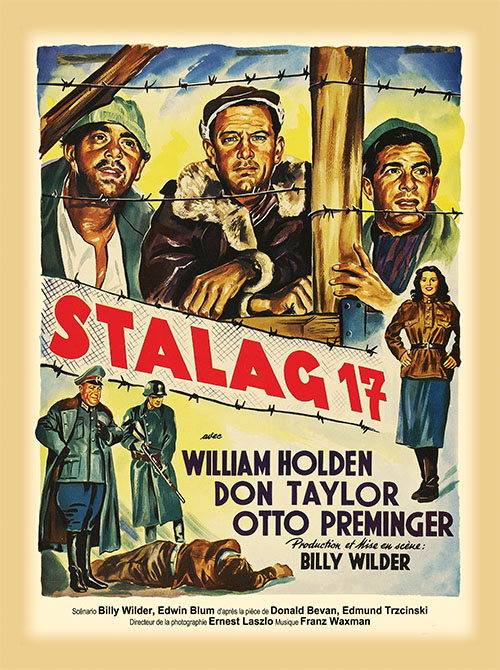
Billy Wilder’s Stalag 17 really has little resemblance to Hogan’s Heroes, the television show which followed it twelve years later.  Sure, they are both comedies set in POW camps during WWII (and both have a buffoonish Sgt. Schultz) but William Holden’s Sefton is about as far as you can get from Bob Crane’s Hogan.  For one thing, Sefton is not a sympathetic character – he’s more of a misanthropic grifter – and the other men do not look up to him (although he does run the still, organises gambling, and other illicit activities).  In fact, the plot of the movie focuses on the presence of a spy in the barracks, feeding information to the camp Commandant (played campily by Otto Preminger, a director in his own right), and everyone suspects Sefton.  There are a few distinctive characters in the barracks, principally Shapiro (Harvey Lembeck) and Animal (Robert Strauss) who clown around and Joey (Robinson Stone) who has been traumatised into a stupor.  As this suggests, the blend of humour and darkness can create an uneasy tension (wry cynicism is a Wilder trademark), although shenanigans and the team effort to defy the Nazis keeps bleakness at bay.  If you’ve only ever watched the TV series, you really should give the film a look.


Thursday, 27 December 2018

Summer with Monika (1953)


☆ ☆ ☆ ☆

Summer with Monika (1953) – I. Bergman

This was Ingmar Bergman’s first big international hit, primarily due to a nude scene by Harriet Andersson which led to the film being recut and distributed as exploitation fare in the US.  Although very tame by modern standards, the story of teenagers who escape their dreary lives to an island in the Swedish archipelago until she falls pregnant and they need to return to reality, was something not seen on American screens due to earlier censorship rules.  Bergman takes the simple plot and adds a lot of sensuality, not just via Andersson but through inserted shots of nature and the elements (credit due to cinematographer Gunnar Fischer).  He offers just enough background to his characters to allow a psychological reading of their personalities and decisions.  Monika (Andersson) is the neglected eldest daughter to an alcoholic father and a mother who has a number of little ones to look after and Harry (Lars Ekborg) is the only son to an ailing father (his mother passed away long ago).  As such, she is selfish and craves attention whereas he is more controlled and overly responsible.  She sparks the decision to flee the city to the islands which leads him to abruptly quit his job (which was already being affected by his being drawn into her orbit), but he is the one who knows when it is time to return to find a career to support her and the child to come.  Of course, this is at the end of the summer.  Thus, the escape to the island can be seen as a fantasy, an idyll quite separate from the otherwise grim real world marked by poverty and hard work -- another “summer interlude” (to reference the title of an earlier film). In the end, Monika herself may be a fantasy for Harry, a specific memory to hold onto that will haunt him far into the future. Bergman’s developing vision of life seems to involve darkness punctuated by isolated and fleeting moments of happiness (which we allow to linger with inevitable mixed feelings).


Saturday, 25 March 2017

Roman Holiday (1953)


☆ ☆ ☆ ☆ ½


Roman Holiday (1953) – W. Wyler

The stars are especially magical in William Wyler’s light-hearted (though ultimately wistful) romantic comedy.  Audrey Hepburn, in her first major role, is innocent and gamine-like (esp. after that haircut) as a princess touring Europe with too many bureaucratic duties to perform.  Gregory Peck, less wooden than usual, is the American reporter who stumbles upon her when she makes a late-night break for freedom from her minders.  The next day, the two (along with photographer Eddie Albert) spend the day visiting Roman tourist destinations (shot on location) in a carefree way but comically underscored by the efforts of the journalists to conceal their identities and true purpose (to get a scoop for their paper).  Of course, Peck and Hepburn fall in love – but, after all is said and done, she is a princess and must return to her duties.  Or must she? Dalton Trumbo came up with the story (while blacklisted as part of the Hollywood 10) and received his Oscar posthumously in the 1990s.  Breezy and special, due primarily to Hepburn’s charisma but Wyler also knew a thing or two about directing and hits the right emotional notes, expertly playing the audience.  Lives up to its reputation.


Tuesday, 23 December 2014

Madame de… (1953)


☆ ☆ ☆ ☆ ☆

Madame de… (1953) – M. Ophuls

A stylish and seemingly superficial offering from Max Ophuls that is actually deceptively complex, deepening dramatically as it progresses.  Danielle Darrieux is Madame de (no surname given, which is something of a running gag) who decides to hock the earrings her husband the General (Charles Boyer) gave to her on their wedding day to support her lavish lifestyle.  Of course, her husband finds out (when Madame decides to pretend they were stolen and the jeweller seeks to clear his name).  The earrings then make a circuitous journey, full circle if you will, becoming imbued with an incredible amount of emotion (more than they had originally).  This is one of the fascinating insights of Ophuls’ film – to see that any old object can become a fetish object.  The alchemy involves true love or at least that deep and exciting passionate attachment that can occur between two people (in this case, Madame de and her Italian lover played superbly by Vittorio de Sica, yes, the neorealist director), sometimes if only for a short while.  However, Madame de is already married and the film juxtaposes her marriage to her illicit love, a partnership of position and appearances (and companionship) versus an intense and absorbing (those dances!) mutual longing.  Of course, one relationship is right and one is wrong (or perhaps Ophuls is daring to question this) and fate (or society) will have its way.  Top it all off with amazing tracking shots and set decoration and you have a masterpiece.  


Sunday, 30 December 2012

Mr. Hulot's Holiday (1953)


☆ ☆ ☆ ☆

Mr. Hulot's Holiday (1953) -- J. Tati

Monsieur Hulot (Jacques Tati) is one of those nonchalant friendly but bumbling characters who lays waste to everything orderly about him (demonstrating the principle of entropy?). The film that encases him (in his first of several appearances) is virtually dialogue-less, or at least the dialogue doesn't matter much, and thus it takes on the shape of a series of silent clown set-pieces a la Keaton or Chaplin.  Tati (who also wrote and directed) pays excruciating attention to the framing of shots, sound effects on the sound track, and the mise en scene as a whole, giving the viewer the sense that the chaos on screen is the product of well-ordered construction indeed. Charmingly French music too.


Saturday, 3 November 2012

Ugetsu Monogatari (1953)


☆ ☆ ☆ ☆ ☆

Ugetsu Monogatari (1953) -- K. Mizoguchi

Mizoguchi's classic probably deserves to be seen on the big screen (and not the small one).  I can only imagine how the peasant village, the fog on Lake Biwa, the haunted mansion and other period sets might look sprawled on that large canvas in the dark. Mizoguchi excels at the long shot, keeping his characters in context, as we watch them buffeted by forces (sometimes supernatural forces) beyond their control (but unleashed through their own actions).  We follow two couples: Genjuro and his wife Miyagi who are potters and have a small son and Tobei and his wife Ohama who are laborers.  Genjuro hopes to get rich by selling his wares during wartime when prices are high; Tobei dreams of becoming a samurai.  Both end up abandoning their wives in their quests for money/power and find themselves somewhat quixotically achieving sexual and military conquests.  Their wives suffer horribly (a Mizoguchi trademark) and, in the end, so do the husbands. This is a ghost story but that is only one part of the tapestry that Mizoguchi weaves of feudal Japan. The natural world that humans have constructed is just as devastating.


Monday, 7 May 2012

The Big Heat (1953)


☆ ☆ ☆ ☆ ½

The Big Heat (1953) – F. Lang

Glenn Ford takes on corruption in his city, entering rooms with his fists flying, and this is after he turns in his badge (but not his gun) to the police commissioner. (Which is the same plot that Jackie Chan adopted for Police Story, come to think of it). Sure, Ford is a righteous law enforcer but he's given plenty of reasons to go insane in this film -- the Big Heat is on him and then he brings it down on the baddies. Gloria Grahame and Lee Marvin throw coffee at each other too. One of Fritz Lang's best.